We may earn a commission if you buy through links on this page. It doesn’t change our picks or the data. Full disclosure.
TL;DR: Lumens tell you how much total light a flashlight puts out. Candela tells you how hard the brightest part of the beam hits, and that is what sets how far you can see. Runtime under FL1 ends at 10% of starting output, not at “dead.” There is no single lumen number every patrol officer needs. There is a way to pick: decide your distance, check the candela, then check weight and battery. We have not tested any light in this article. Every number below is from the maker.
What FL1 is, and what it isn’t
ANSI/PLATO FL1 is a flashlight rating standard. According to Streamlight’s summary of it, it was developed with guidance from the American National Standards Institute, the National Electrical Manufacturers Association, the Portable Lights Trade Organization (PLATO), and representatives from 14 companies in the portable lighting industry. It exists so buyers can compare claims.
Two things to know:
- Using it is voluntary. Streamlight’s own presentation says adherence and reporting are “strictly voluntary.” A light with no FL1 icon is not necessarily dishonest, but its numbers can’t be compared the same way.
- The maker does the testing. Companies can run the tests themselves or use an outside lab. If one claim on a package follows FL1, all claims on it must.
The numbers, one at a time
| FL1 number | Unit | What it means | The catch |
|---|---|---|---|
| Light output | lumens | Total light emitted, measured by integrating the whole beam | Says nothing about how that light is spread |
| Peak beam intensity | candela (cd) | Brightest spot in the beam, typically on the center axis | Doesn’t change with distance |
| Beam distance | meters | Distance where the beam falls to 0.25 lux | Streamlight likens 0.25 lux to a full moon on a clear night in an open field |
| Run time | hours or minutes | Time from the 30-second starting output until output drops to 10% of it | The end of the runtime is a dim light |
| Impact resistance | meters | Dropped onto a solid surface from the claimed height (minimum 1 m); must not crack or break and must still work | Only as good as the maker’s claimed height |
| Water resistance | IPX rating | IPX4 splash, IPX7 temporary immersion, IPX8 continuous immersion | IPX7 is tested at 1 m depth |
Definitions from Streamlight’s FL1 presentation, checked 2026-11-11.
Lumens versus candela
A lumen counts all the light. A candela counts the light in the tightest part of the beam. Two lights can put out the same lumens and behave differently: one throws a tight beam a long way, one fills a room.
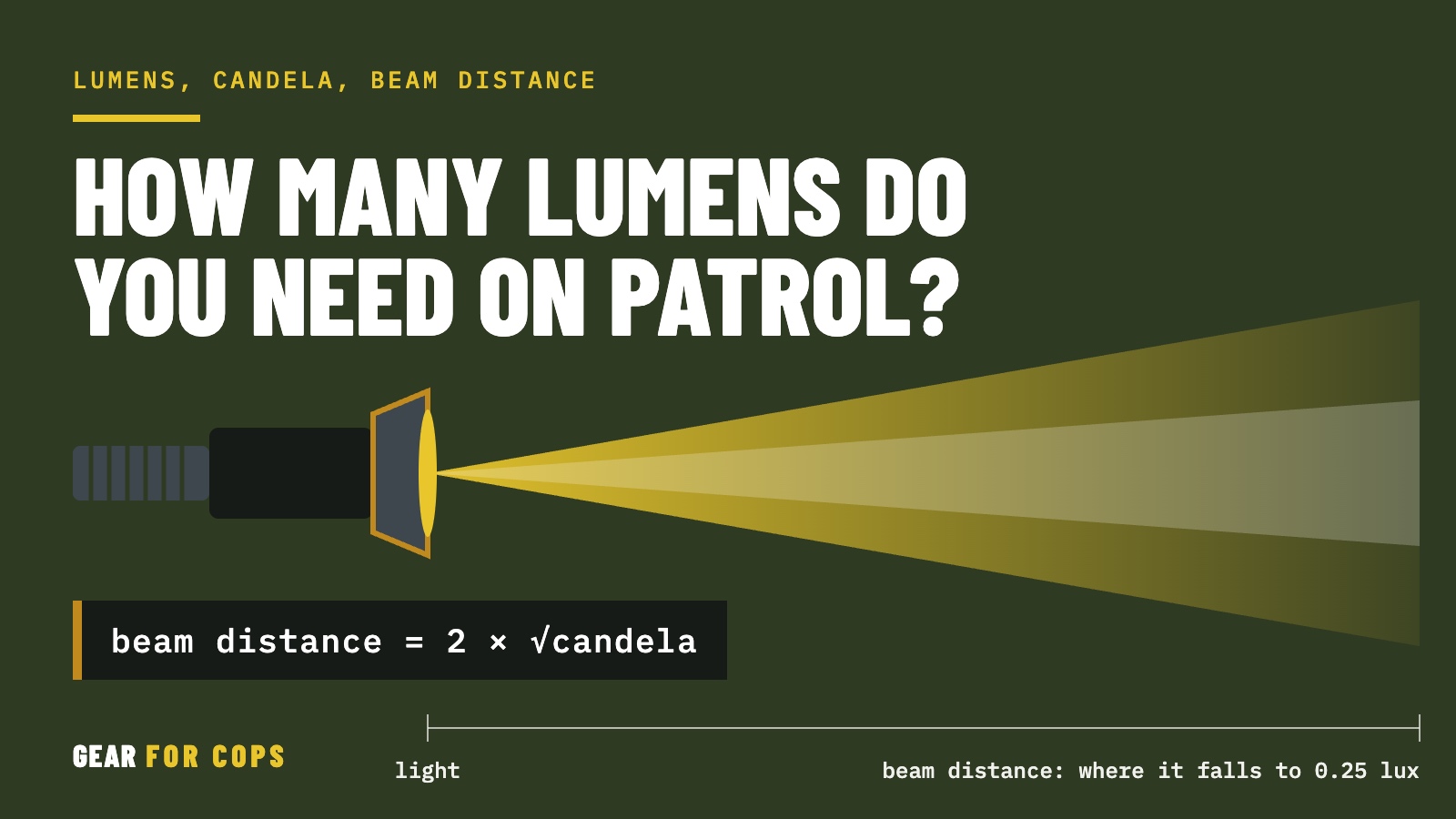
Beam distance comes from candela, not lumens. The FL1 formula is the square root of (peak beam intensity divided by 0.25 lux). Olight’s explainer puts it as 2 times the square root of candela. Check it against a spec sheet:
- ProTac 2L-X: 6,800 cd gives about 165 m. The maker lists 165 m.
- Stinger 2020: 25,000 cd gives about 316 m. The maker lists 315 m.
- Warrior X 4: 99,310 cd gives about 630 m. The maker lists 630 m.
If the candela and distance on a spec sheet don’t agree, ask why before you buy.
Runtime ends at 10%
“Runs 2 hours” does not mean two hours at full brightness. Per the FL1 definition, the clock stops when output falls to 10% of its value at 30 seconds. Some lights step down in output during a run, so the number on the box can include a long, dim tail. Olight’s explainer makes the same point. Read the runtime together with the output level it was measured at.
Same family, very different numbers
Here is what Streamlight lists for four of its lights, High mode, plus one Olight for contrast. Streamlight is the most-named brand in our own flashlight count (below). This is not a recommendation and not a ranking.
| Light | Lumens | Candela | Beam distance | Weight (maker) |
|---|---|---|---|---|
| ProTac 2L | 350 | 6,300 | 159 m | 2.8 oz (CR123A) |
| ProTac 2L-X | 500 | 6,800 | 165 m | 3.9 oz (CR123A), 4.4 oz (SL-B26) |
| ProTac HL-X | 1,300 | 35,000 | 374 m | 5.7 oz (CR123A), 6.2 oz (SL-B26) |
| Stinger 2020 | 2,000 | 25,000 | 315 m | 12.3 oz |
| Olight Warrior X 4 | 2,600 | 99,310 | 630 m | not shown on the page we loaded |
Maker spec pages, checked 2026-11-11. The ProTac HL-X row uses the maker’s SL-B26 figures; on CR123A it lists 1,000 lm, 27,100 cd and 330 m. Olight’s page listed the Warrior X 4 at $129.99 on the check date; we did not check Streamlight prices.
Three things jump out. The numbers are the makers’; the reading of them is ours.
Going from 350 to 500 lumens barely moved the beam. The ProTac 2L to the 2L-X is about 43% more lumens, but candela went up about 8% and beam distance from 159 m to 165 m. Our read: the extra lumens went mostly into the spill around the hotspot, not into reach.
The Stinger 2020 has more lumens than the HL-X and throws less far. 2,000 lumens against 1,300, but 315 m against 374 m. The HL-X puts its light into a tighter beam. Weight is the other side of that trade: 12.3 oz against 6.2 oz.
The same light changes with its battery. The HL-X is listed at 1,300 lm on the rechargeable pack and 1,000 lm on CR123A cells.
So how many lumens?
We won’t give you one number. Here is a way to decide. This is our reasoning, not part of the FL1 standard; the numbers in it are the makers’.
- How far do you actually need to see? If the answer is across a lot or down an alley, buy on candela and beam distance. If it is a car interior or a hallway, lumens and a wide beam matter more, and a very tight beam is a drawback.
- Can you go low? Look at the low mode. The maker lists 40 lm for the 2L-X, 70 for the HL-X and 100 for the Stinger 2020. A bright light with no usable low setting is harder to use up close.
- How long will you need it? Check runtime at the mode you will use, not at “turbo.” The 2L-X is listed at 2.75 hours on High with CR123A and 30 hours on Low. The HL-X on the pack is listed at 1.5 hours High and 25 hours Low.
- What will you carry? Weight is the next section.
Our own count points the same way, with a small sample. We asked what flashlight you run. Eight people named a light, nine mentions in all, from a poll and a gear thread: Streamlight 4 (Megastream twice, HLX and PT1-L), Olight 2, Inforce TFX 1, Nitecore 1, Modlite 1. That’s eight people. It tells you what a few officers carry. It tells you nothing about which light is best.
Batteries: CR123A, 18650/21700, built-in USB-C
- CR123A is a 3 V lithium cell about 34.5 mm tall (Wikipedia). Streamlight’s ProTac 2L-X and HL-X both run on CR123A or on the maker’s rechargeable pack. Disposable lithium is simple and you can carry spares. You pay per cell.
- 18650 and 21700 are rechargeable lithium-ion cell sizes named by their dimensions: 18650 is about 65 mm long, and 21700 is 21 mm across and 70 mm long (Wikipedia). Olight’s Warrior X 4 page offers its own 3.6 V, 5000 mAh 21700 cell, sold for the Warrior series, as the matching battery. Protection circuits can add to a cell’s length, so a “protected” cell may not fit a tube built for a bare one.
- Built-in USB-C charging means the battery pack carries its own charge port. Streamlight’s SL-B26 is a Li-ion pack with a built-in USB-C charge port; the maker lists it at 1.7 oz (48 g) and a 5-hour charge. The Warrior X 4 also charges by USB-C.
Rechargeable is cheaper to run. The trade: a dead rechargeable on a long shift needs a charger or a spare. Check your agency’s rules on charging personal gear in the unit.
Weight on a 12-hour shift
From the maker pages above:
- ProTac 2L: 2.8 oz
- ProTac 2L-X: 3.9 to 4.4 oz
- ProTac HL-X: 5.7 to 6.2 oz
- Warrior X 4: Olight’s product page did not show a weight when we loaded it
- Stinger 2020: 12.3 oz, about three-quarters of a pound
The gap between the lightest and heaviest Streamlight here is 9.5 oz, more than half a pound, before you add a holster or ring. Whether that matters depends on where you carry it and what else is on your belt. We haven’t carried these, so we won’t say how it feels.
Reading a spec sheet in a minute
- Look for the FL1 icons. If one claim on the package follows FL1, the standard says all of them must. No icons means the numbers may not be comparable.
- Check candela against beam distance. Distance in meters should be close to 2 times the square root of candela. Every Streamlight and Olight figure in this article passes that check.
- Find runtime for the mode you will use. The ProTac 2L-X lists 2.75 hours on High with CR123A and 3.25 hours with the SL-B26 pack. Same light, different battery, different number.
- Read the water and drop ratings. The makers list the ProTac 2L-X as waterproof to 1 m for 30 minutes and 2 m impact tested, the ProTac HL-X as IP68 (dust tight and waterproof to 2 m) and 2 m impact tested, and the Stinger 2020 as IPX7 and 2 m impact tested.
- Note the battery. If your unit or agency stocks one cell type, a light that runs on it is easier to keep going.
Keep going
More on lights lives in Lights, our other buyer guides and the officer picks. See what officers named for belts in Duty belts officers named most. Buying for someone else? The squad gift guide covers a rechargeable light. How we choose what to list is on How we pick.
Sources
- Streamlight: ANSI/PLATO FL1 Standard presentation, checked 2026-11-11. Definitions of light output, peak beam intensity, beam distance, run time, impact and water resistance.
- Olight: ANSI FL1 Standard, six numbers every spec sheet needs, checked 2026-11-11. Beam distance as 2 times the square root of candela; runtime counts to 10% of starting output.
- Streamlight ProTac 2L, ProTac 2L-X, ProTac HL-X, Stinger 2020, SL-B26 battery, all checked 2026-11-11.
- Olight Warrior X 4, checked 2026-11-11.
- Wikipedia: List of battery sizes, checked 2026-11-11, for CR123A, 18650 and 21700 dimensions.
- Our flashlight count: comments on an October 23, 2026 flashlight question post and on an earlier October gear thread, both on Instagram. Eight people named a light; nine brand mentions.