We may earn a commission if you buy through links on this page. It doesn’t change our picks or the data. Full disclosure.
TL;DR: Your academy’s official list beats every other list, including this one. Academy lists differ a lot: one bans smart watches and wants high-gloss boots hand-polished with real wax, another wants a laptop, another wants Dickies shirts in a specific model number. So this guide does three things. It shows what four real academy lists ask for. It sorts gear into buy now, skip, and wait for department issue. And it covers boot break-in and gear care. Our own advice: buy the cheap, universal items first (running shoes, socks, notebook, pen, watch, bottle), break in boots early, and don’t buy duty gear until your academy or agency tells you to. We haven’t tested any product here.
In this guide
- Start with your academy’s official list
- How we sort gear: buy, skip, wait
- What four academy lists actually ask for
- Physical training gear
- Uniforms: buy only what the list names
- Boots: the item that can hurt you
- Notebooks, pens and paper
- Flashlight
- Watch
- Bags
- Laptops and tech
- Items to wait on: department issue
- Items to skip
- Gear care: keep it working
- When to buy what: a rough order
- Prices we verified
- FAQ
- How we chose
- Related
- Sources
Start with your academy’s official list
Before you buy anything from this page, get the document your academy or agency actually sent you. It may be called a “student needs list,” an “equipment list,” a “basic police checklist,” or “required clothing and equipment for cadets.” Those are the names on the four lists we read.
Why this matters: the lists conflict. We read four on Nov 11 and re-checked each against the original PDF on Nov 12, 2026:
- Oregon DPSST “Basic Police Checklist”
- Louisiana State Police “Required Clothing and Equipment for Cadets”
- The Academy (San Jose, California) “Student Needs List” for Basic Academy Modular Level Three, revised March 2026
- Weber State Police Academy (Utah) “Equipment List”
These are examples, not a national standard. Your academy’s list can be different from all four. Anything on this page that disagrees with your list is wrong for you.
Two timing rules appear in the lists and are worth knowing now:
- Confirm the class is running before you buy. The San Jose list says “the purchase of equipment should be done after confirming that the class will be offered,” because classes depend on enrollment. It also says the reservation deposit is non-refundable if you cancel less than 21 days before the start date.
- Don’t bring duty gear until told. The Louisiana list says, in capital letters, “DO NOT BRING FIREARMS EQUIPMENT ON DAY ONE OF TRAINING.” The San Jose list says no duty belt on the first day and no firearms until the coordinator directs. Oregon is the opposite: it tells students to bring a duty pistol at check-in, secured in an approved holster or gun box, for storage in an issued locker. That is one more reason to read your own list.
Our advice: put the list in front of you, then use this page to understand it and to fill gaps.
How we sort gear: buy, skip, wait
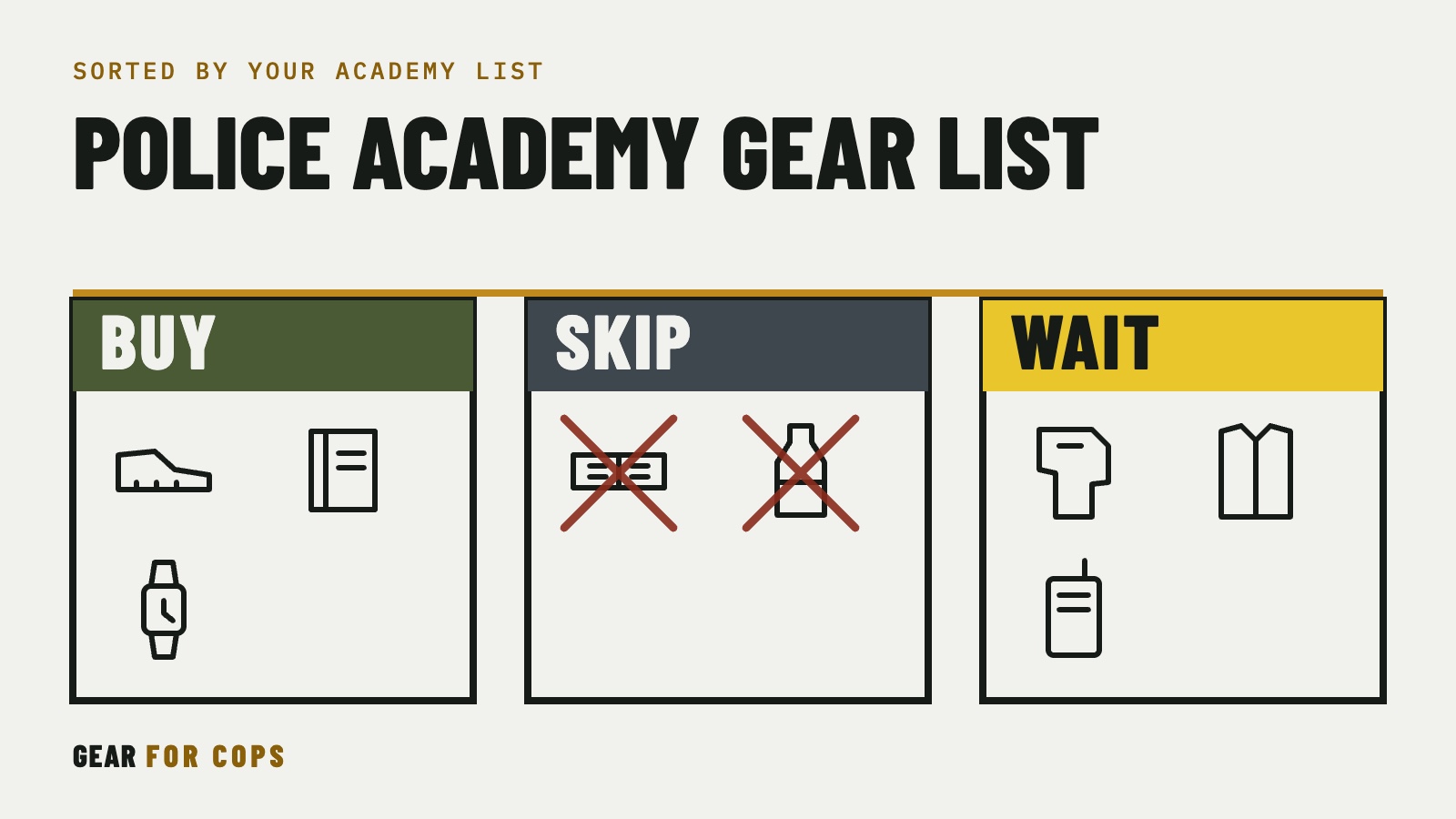
- Buy: Items that appear on most lists, don’t depend on agency rules, and are safe to purchase early. Running shoes, socks, notebooks, a watch, a bottle, care supplies.
- Skip: Items that lists restrict, that duplicate issued gear, or that you can’t return if the list changes. We name what the lists prohibit.
- Wait: Items the department may issue, or that the academy will tell you to bring later. Duty weapon, holster, belt, vest, radio, uniform pieces.
This is our sorting, based on the four lists. Treat it as a way to ask the right questions, not as a rule.
What four academy lists actually ask for
This is our tally, not a published statistic. We read each list and marked an item “Y” if it appears. A dash means we didn’t see it listed. “Later” means the list says to bring it when instructed.
| Item | Oregon DPSST | Louisiana State Police | The Academy (San Jose) | Weber State |
|---|---|---|---|---|
| Duty boots | Y | Y | Y | Y |
| Flashlight | Y | Y (later) | Y | Y |
| Running or athletic shoes | Y | Y | – | Y |
| Handcuffs | Y | key only | Y | Y |
| Duty belt | Y | – (inner belt suggested) | Y (not day one) | Y |
| Mouthguard | Y | Y | – | Y |
| Laptop or device | Y | issued laptop assumed | Y | Y |
| Notebook or notepad | Y | 3-ring binder | Y | – |
| Shoe-shine supplies | Y | Y | implied (hand shine, real wax) | – |
| Water bottle | Y | Y | – | – |
| Wristwatch | – | – | Y (no smart watches) | – |
| Hearing and eye protection | safety glasses optional | – | Y | Y |
| Ballistic vest | Y | – | – | – |
What the table shows: only boots and a flashlight appear on all four lists. Everything else varies. That is the argument for following your own list. For the items that matter most, the list names a spec, not just a category.
Physical training gear
Physical training (PT) gear is the safest early buy because it doesn’t depend on agency policy. Even here, the lists have rules.
- Running shoes. Weber State asks for running shoes with “good arch/ankle support to help prevent injury.” Louisiana asks for a quality high-mileage pair in a neutral color (black, dark blue or dark gray) and says no fluorescent colors. Oregon asks for a separate pair of non-marking athletic shoes for the gym, worn only indoors, plus a mat-room shoe that may be the same pair.
- PT clothing. Oregon asks for four black T-shirts with no pockets or logos, two long-sleeve shirts, and black or navy shorts or sweatpants. Louisiana asks for black compression shorts for PT and specific military-style PT uniform pieces. Weber State asks for academy PT shirts with your last name on the back. It listed the cost at $12.95 per shirt, with a minimum of two required.
- Reflective gear. Weber State asks for a reflective running vest.
- Protection. Oregon, Louisiana and Weber State all ask for a mouthguard. Weber State also asks for a protective cup. Oregon lists optional knee pads and safety glasses.
- Cold weather. Louisiana asks for a plain black watch cap and black gloves for cold-weather PT.
How fit do you need to be?
This varies, and your list may not say. The San Jose list, for the Level Three module, says no formal fitness training is required. It does give day-one minimums for students going on to Level One: a sustained jog of at least 20 minutes (about 2 miles), a plank of about 60 seconds, at least 30 bent-leg sit-ups in a minute, at least ten four-count burpees, and at least ten full pushups. Level One runs range from 2 to 6 miles.
That is one California module, not a national benchmark. Use it as an example of how specific a standard can be. Our advice: ask your academy for its physical standard, and start training before you pay for gear.
Uniforms: buy only what the list names
Uniform lists are the most specific part of any academy document.
- Louisiana names Dickies long-sleeve dark navy work shirts (model 574DN) and Dickies dark navy trousers (model 874DN), five of each, plus khaki cargo pants for firearms and driving training.
- Weber State asks for two navy polo shirts with your name stitched on the front, khaki and navy pants of “approved styles only at uniform vendors,” and lists approved vendors.
- San Jose issues a gray polo and a black ball cap through the academy and says other uniform pieces may be bought from named vendors or online.
- Oregon lists “Department issued uniform” among required equipment.
If you are agency-sponsored, you may not buy any of it. The San Jose list says agency students may wear agency-approved duty gear. Our advice: don’t buy a single uniform piece until you have the list and, if you’re sponsored, confirmation from your agency.
Boots: the item that can hurt you
Boots are the highest-risk purchase because they are expensive, they have rules, and they take time to break in.
What the lists require
| Academy | Boot rules we read |
|---|---|
| Louisiana State Police | Black, all-leather, broken-in; plain seamless toe; lace-up only (hook-and-loop or zipper fasteners prohibited); at least 6 inches high; shined before reporting, and no “Leather Luster.” Patent leather, Corfam, nylon and mesh on any part are prohibited. The list gives examples: Lacrosse Taser HD, Rocky Chukka, Altama leather boots and Lowa R-6-QTX. Also asks for a separate pair of all-weather range boots |
| The Academy (San Jose) | Black, plain-toed, military or police type; high-gloss shine by hand with real wax; no “Leather Lust” or similar product; no patent leather. Shows example boots in photos |
| Weber State | Black shiny boots with no insignias; high or low boot is okay |
| Oregon DPSST | “Duty boots,” no further spec on the list we read |
Break-in
Don’t wear new boots for the first time on day one. HAIX, a boot maker, says its boots are made from bullhide leather and need a break-in period so the leather can conform to your foot, and says to wear a new pair for shorter periods before committing to a full shift. The company adds that break-in time varies by wearer and conditions. That is HAIX’s guidance for its boots, and other makers have their own, but the idea carries over to any stiff leather boot. Our advice:
- Buy boots as soon as your list allows and the class is confirmed. Louisiana wants them broken in before Day One.
- Wear them around the house first, then on short walks, then for hours.
- Wear them with the socks you’ll wear in class. A boot that fits with thin socks may not with thick ones.
- Check the fit before you commit. Make sure you can return them, and read the maker’s size guide.
Price
Boot prices vary widely. As one data point, LOWA’s task force boot page listed a Zephyr GTX Mid TF at $188, a clearance price marked down from $250, when we checked on Nov 12, 2026. That is one boot from one maker, not a range. Check the price of the boots your list names. See our boots page for what we track.
Socks
The Louisiana list asks for a minimum of five pairs of black cotton uniform socks and five pairs of black no-show socks for PT. If your list lets you pick, a boot sock is a cheap upgrade. Darn Tough’s Boot Midweight Tactical 3-pack is listed by the maker as made in the USA, 62% merino wool, and “Unconditionally Guaranteed for Life,” at about $90 when we checked. San Jose says uniform socks may be any color but must not be visible while wearing boots.
Notebooks, pens and paper
Lists treat paper differently, and the specs are small but real:
- San Jose asks for a small notepad that fits a shirt pocket, college-rule binder paper, at least two No. 2 pencils, a medium-point black ink pen, a highlighter, and correction fluid or tape.
- Oregon asks for a “police notebook.”
- Louisiana asks for a 5-inch black 3-ring binder, a black permanent clothes marker and a calculator (TI-35, Casio fx-260 or equivalent).
If you want a weather-proof option, Rite in the Rain’s Law Enforcement Notebook is described by the maker as 56 numbered all-weather sheets in a legal pattern that “meets valid testimony requirements.” That is the maker’s claim; check with your prosecutor’s office before relying on it. Fisher’s Space Pen uses a sealed, pressurized cartridge the maker says writes upside down and in extreme temperatures. Check whether your academy wants a specific format before buying.
Flashlight
The flashlight is on all four lists, but the spec differs:
- Oregon: a full-size flashlight and a smaller personal carry flashlight, with charger if needed.
- San Jose: at least 300 lumens, pressure-activated, for night range qualification; rail-mounted lights are allowed but can’t be used for testing.
- Louisiana: full-size or Stinger-size, preferably rechargeable, to be brought when instructed.
- Weber State: a flashlight, preferably rechargeable, plus a holder for the belt.
Louisiana’s reference is a Streamlight Stinger LED HL rechargeable. Streamlight lists it at 800 lumens, 24,000 candela and a 310 m beam on high, with a 1.5 hour runtime on high, about 12.4 oz, a NiMH rechargeable battery, IPX4 water resistance and a limited lifetime warranty. Streamlight lists a full recharge within 16 hours on the Steady Charger or 4.5 hours on the Smart Charger (USB input). We haven’t tested it.
Our advice: don’t buy a light until your list names the spec. If you want to understand the numbers, read how many lumens you need on patrol. Our lights page lists what we track.
Watch
Only San Jose lists a watch, and it is strict: a wristwatch with a black band, and “NO SMART WATCHES.” A plain digital works. Casio’s A158WA-1 is a metal-band digital with a stopwatch, listed with about a 7-year battery, at about $29.95 when we checked. The maker lists “water resistant,” which is not a depth rating. Because San Jose wants a black band, a silver-band watch might not pass at that academy. Read your list before buying.
Bags
- Louisiana: one black backpack large enough for an issued laptop, accessories and classroom materials, and it says no messenger bags.
- San Jose: shows a black patrol duty bag (one with a shoulder strap recommended) next to a black backpack that can carry a baton.
Our advice: start with a black backpack, which fits Louisiana’s rule and San Jose’s backpack item, and ask whether your academy also wants a duty bag. See our bags page for what we track. Don’t buy a large patrol bag until you know the list, since academy classroom bags and patrol bags are different jobs.
Laptops and tech
Three of the four lists ask for a laptop or device. Oregon says to bring a device that can open PDFs, connect to the internet and has a USB port, and recommends a laptop. San Jose requires a laptop during class to access its learning-domain books. Weber State requires a laptop and offers rentals through the academy for $150 with a $25 refund at course completion. Louisiana’s list assumes an academy-issued laptop. Check before you buy one.
Items to wait on: department issue
Wait on anything the agency might supply or that your academy tells you to bring later.
| Item | Why wait | What the lists say |
|---|---|---|
| Duty pistol | Agency-sponsored recruits may be issued a weapon, and academies set caliber and model rules | San Jose: agency-sponsored students should contact their employer for their weapon; self-sponsored students choose, within the academy’s rules. Oregon sets caliber and magazine rules |
| Holster and belt gear | Specs differ and gear must match | San Jose requires matching appearance and basket-weave leather for self-sponsored students; Weber State says no Serpa-type holster |
| Ballistic vest | Fit and the NIJ standard matter; ask the agency | Oregon lists a ballistic vest as required; NIJ keeps a Compliant Products List by model |
| Uniform pieces | Specs differ by academy | Oregon lists a “Department issued uniform”; Louisiana names exact models |
| Radio carrier, Taser holster | Depend on the agency’s equipment | Oregon lists both, with Taser holster “unless your agency does not use tasers” |
| Handcuffs and key | Academies may restrict type | Weber State says hinged handcuffs are not acceptable; Louisiana asks for a universal handcuff key |
| Baton, OC holder, blue gun | Often specified exactly | San Jose lists a 26-inch or 29-inch straight baton, an OC holder, and a weighted Ring’s Manufacturing blue gun that matches your holster |
NIJ says that officers should keep wearing the armor they have now if it was certified to the older standard, and that it expects to keep that list through at least 2029. NIJ also says it has never tested or certified ballistic items such as backpacks, blankets or briefcases. Check any “NIJ-certified” claim against the NIJ list by model.
Items to skip
These are drawn from what the lists prohibit or caution against, plus our own judgment.
- Hook-and-loop or zipper boots. Louisiana prohibits them. Boots with patent leather, Corfam, nylon or mesh are out there too.
- Liquid boot polish and “leather luster” products. Louisiana says paste polish only. San Jose says no “Leather Lust” or similar.
- Messenger bags. Louisiana prohibits them for the classroom bag.
- Fluorescent running shoes. Louisiana says neutral colors only.
- Hinged handcuffs and Serpa-type holsters at Weber State.
- Firearms equipment before you’re told. Louisiana and San Jose both say not to bring firearms gear until told, and Weber State puts its firearms items in a later module.
- Anything you can’t return. Lists change, and the San Jose list says its requirements are subject to change.
- Costume gear. A tactical vest, patches or a badge do nothing for you at the academy. This is our opinion, not a rule on the lists.
Gear care: keep it working
Care is part of the job at several academies, which grade appearance.
- Boots. Danner says its full-grain and suede or nubuck boots have separate conditioning guides, so find your boot’s material first. LOWA’s care tips say to dry wet boots in a well-ventilated room, away from heat, and never by a radiator, near an oven, in the sun or in a hot car. Wet leather can crack. LOWA also says to remove the laces and insoles when cleaning.
- Shine supplies. Louisiana asks for black paste shoe polish (no liquid) and brass cleaner paste (no liquid). Oregon lists shoeshine supplies as required.
- Laundry. Louisiana asks for a large mesh laundry bag and a combination padlock. Oregon asks for clothes hangers.
- Batteries and chargers. Charge your light the way the maker says. Streamlight lists charging times by charger type for the Stinger LED HL. Keep the charger with the light.
- Rotate pairs. Our advice: have two pairs of everything that gets wet. The Louisiana list asks for five of most uniform clothing items, which, in our read, says the same thing.
When to buy what: a rough order
This is our suggested order, not a rule.
- When you get the list: read it twice, then ask the academy about anything unclear.
- Once the class is confirmed: buy PT gear, socks, a notebook, a pen, a watch, a bottle, and any items that need break-in.
- Start boot break-in: as soon as you have them.
- Wait for the academy’s say-so: firearms gear, duty belt, holster, vest, and anything the list says “bring when instructed.”
- After you start: buy replacements and extras once instructors tell you what wears out.
Field training comes after the academy. The National Policing Institute reports a 2022 survey finding an average of 12.6 weeks of field training. Don’t spend a lot early on gear you may be told to replace. If you want a gift-focused version, see police academy graduation gifts and gifts for police officers.
Prices we verified
Maker prices re-checked and academy-list prices re-read from the PDFs on Nov 12, 2026. These are listed prices from makers and the academy lists, not totals.
| Item | Listed price | Source |
|---|---|---|
| Casio A158WA-1 watch | about $29.95 | casio.com |
| YETI Rambler 20 oz Tumbler | about $35 | yeti.com |
| Darn Tough Boot Midweight Tactical 3-pack | about $90 | darntough.com |
| LOWA Zephyr GTX Mid TF | about $188 (clearance, marked down from $250) | lowaboots.com |
| Weber State PT shirt with name | $12.95 each, minimum two | Weber State list |
| Weber State laptop rental | $150, $25 refund at completion | Weber State list |
We don’t give a total because lists differ and prices change. Add yours up from the list and the vendors your academy names.
FAQ
What should I buy before police academy?
Our advice: running shoes, socks, a notebook and pen, a plain watch, an insulated bottle and boot-care supplies, as long as your list agrees. Wait on duty gear, uniform pieces and anything the list says to bring later.
What do I need to bring on the first day of police academy?
It depends on your academy. Louisiana says cadets must bring everything on its list on Day One except firearms equipment and items it marks “do not bring until instructed,” and San Jose says students must be in their academy uniform, with no duty belt and no firearms. Read your own list.
Do I need to buy my own uniform for police academy?
Maybe not. Oregon’s list says “Department issued uniform.” Louisiana names specific models cadets buy. San Jose issues a polo and cap. Agency-sponsored recruits should ask their agency first.
How do I break in police boots?
Wear them for short periods first, then longer. HAIX says its leather boots need a break-in period and recommends wearing a new pair for shorter periods before committing to a full shift. Use the socks you’ll wear in class. Start early, because some academies, like Louisiana, want boots broken in on Day One.
Can I wear a smart watch at police academy?
Not at every academy. The San Jose list asks for a wristwatch with a black band and says “NO SMART WATCHES.” Check your own list.
What flashlight do I need for police academy?
It depends. Oregon wants a full-size light and a smaller carry light; San Jose wants at least 300 lumens and pressure-activated for night qualification; Louisiana wants a full-size or Stinger-size light, preferably rechargeable. Don’t buy until your list names a spec.
What should I not buy for police academy?
Skip anything your list prohibits: hook-and-loop or zippered boots, liquid polish, messenger bags, hinged handcuffs, and duty gear before you’re told to bring it. Also skip anything you can’t return.
How much does the police academy gear list cost?
We can’t say. Lists differ and prices change. Add up the items on your own list at the vendors your academy names. We verified a few prices in the table above.
Where can I find my police academy’s official gear list?
On your academy’s website, in your enrollment packet, or from the academy coordinator. The four we read were published as PDFs on the academies’ own sites.
How we chose
We read four published academy lists on Nov 11 and re-checked them on Nov 12, 2026, sorted items by how many lists ask for them, and checked product claims against makers’ own pages. We haven’t tested any product, and we don’t claim these four lists represent every academy. Our method is on How we pick. Browse more in Buyer guides, boots, bags, lights and all gear.
Related
- Police academy graduation gifts that actually help in field training
- Gifts for police officers: a practical guide for spouses, parents and partners
- How many lumens do you actually need on patrol?
- Duty belts officers named most
- What to get your squad for Christmas
- Officer picks
Sources
All checked Nov 12, 2026.
- Oregon DPSST: Basic Police Checklist
- Louisiana State Police: Required Clothing and Equipment for Cadets
- The Academy (San Jose, CA): Student Needs List, Basic Academy Modular Level Three, rev. 3-2026
- Weber State Police Academy: Equipment List
- HAIX: All footwear (break-in statement)
- Danner: conditioning leather
- LOWA: care tips
- LOWA: Task Force (Tactical) boots
- Streamlight Stinger LED HL
- Casio A158WA-1
- Rite in the Rain: Law Enforcement Notebook (No. 1023)
- Fisher Space Pen FAQ
- Darn Tough: Boot Midweight Tactical 3 Pack
- YETI drinkware
- NIJ: Compliant Products List, Ballistic Resistant Body Armor
- National Policing Institute: The Crucial Role of Police Field Training