We may earn a commission if you buy through links on this page. It doesn’t change our picks or the data. Full disclosure.
TL;DR: The only way to confirm a vest or plate is NIJ certified is to find its exact model on NIJ’s Compliant Products List (CPL), then match the manufacturer, model designation and threat level on the CPL row to the label sewn into your panel. A maker saying “NIJ rated,” “meets NIJ,” or “tested to NIJ” proves nothing by itself. NIJ says to keep wearing the armor you have now, and it expects to keep the older 0101.06 list through at least the end of 2029. In 2025 NIJ removed three models and barred two companies from its program after a federal smuggling and counterfeit-label case that ended in a guilty plea, so a model’s listing status matters. This is information, not a guarantee. Your agency’s armor policy and your armor maker’s instructions come first.
The 60-second check
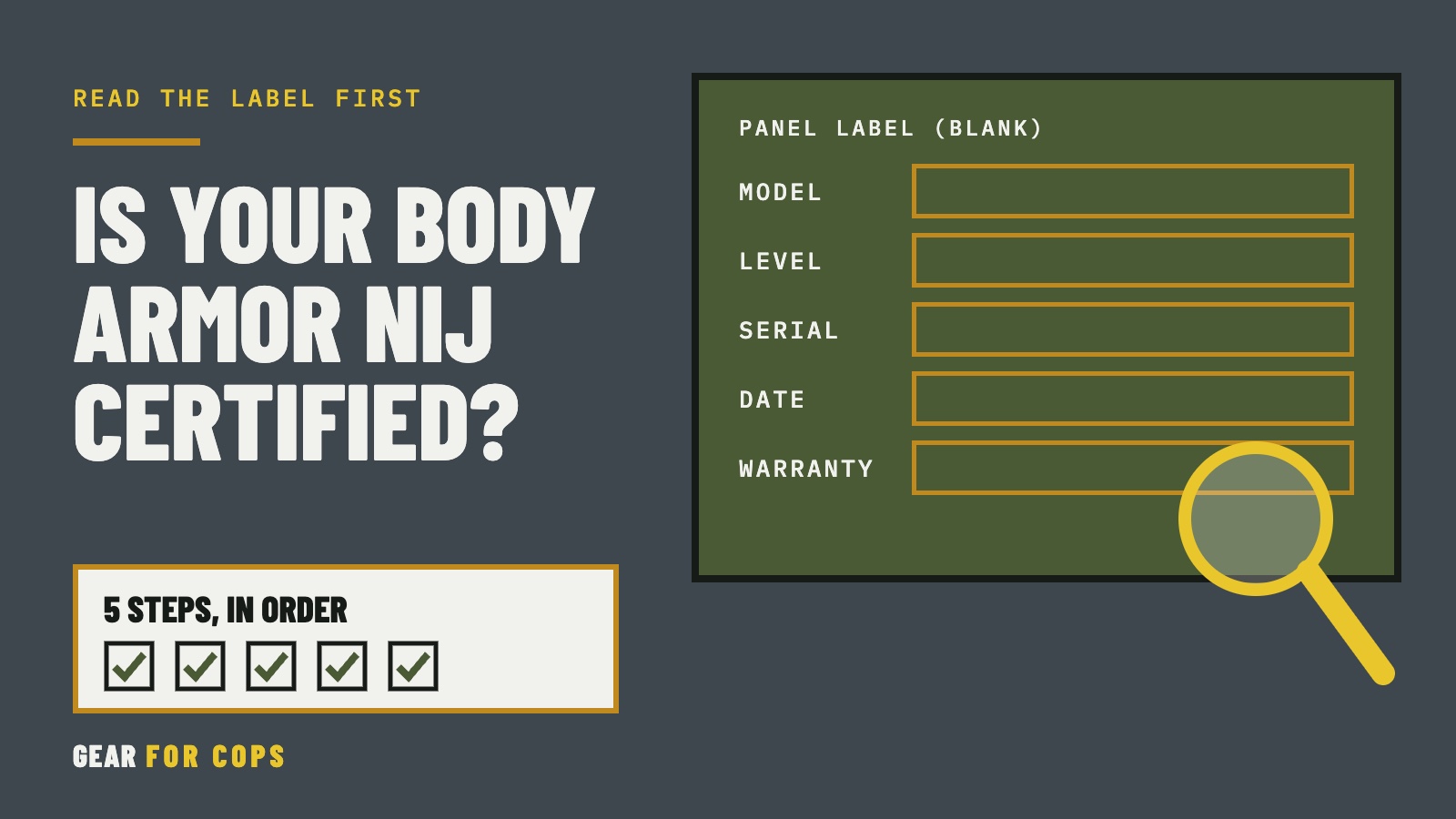
Do these five things, in this order. Each one is explained below.
- Read the label on the panel (or plate) and write down the manufacturer, model designation, threat level, serial number and date of manufacture.
- Open the NIJ Compliant Products List and choose the table for the standard your label names (0101.07 or 0101.06).
- Filter by manufacturer (the list calls this the Listee or Listed Company) and find your exact model designation.
- Confirm the threat level and the warranty on the row match your label, and that the status reads Active.
- Look for the NIJ mark on the label, and check that the date of manufacture is inside the warranty period the label states.
If any step fails, stop and call your armor maker and your agency’s armor coordinator before you rely on the vest. Don’t throw it away on our say-so, and don’t keep trusting it on a seller’s say-so either.
What “NIJ certified” actually means
NIJ is the National Institute of Justice, the research arm of the U.S. Department of Justice. It runs the NIJ Compliance Testing Program (CTP). NIJ says it “certifies torso-worn ballistic resistant body armor for law enforcement” that meets the program’s requirements (NIJ Compliant Products List page, checked Nov. 12, 2026).
Here is how a model gets there, per NIJ’s compliance testing page:
- The manufacturer registers with the program and submits application documents.
- It sends model samples to an NIJ-approved laboratory. NIJ requires that lab to be accredited, independent, third-party, and to do the compliance testing in the United States.
- It agrees to follow-up inspection and testing. NIJ says each manufacturer with a compliant model is subject to six follow-up inspections and testing over a five-year period.
- It declares a period of ballistic warranty.
Two points matter for you. First, certification belongs to a model, not to a brand. A company can have listed models and also sell products that were never tested. Second, NIJ says it “has never tested nor certified” other ballistic items, “such as backpacks, blankets, or briefcases.” The Justice Department put it more bluntly in a 2018 statement: “Marketing that claims NIJ testing or certification for such products is false” (DOJ statement, Feb. 28, 2018).
How to use the NIJ Compliant Products List, step by step
The CPL lives on one NIJ page: Compliant Products List: Ballistic Resistant Body Armor. Bookmark it. Stab-resistant and combination armor are listed separately, according to NIJ.
Step 1: Pull the facts off your label first
Before you open the list, get the label in front of you. Photograph it. You need the manufacturer name, the model designation, the standard it names, the rated threat level, size, serial number, and date of manufacture. If the label is unreadable or missing, that is already a finding. NIJ’s own labeling rules say labels must be permanent and durable enough to stay attached and fully legible “for the life of the armor” (NIJ Standard 0101.06, section 4.1.5.3).
Step 2: Choose the right table
The CPL page has two tables, one per standard (checked Nov. 12, 2026):
| NIJ Standard 0101.07 table | NIJ Standard 0101.06 table | |
|---|---|---|
| Manufacturer column | Listee Name | Listee Name (filter calls it “Listed Company”) |
| Threat level values | New names (HG1, HG2, RF1, RF2, RF3) | Old names (IIA, II, IIIA, III, IV) |
| Other columns | Model Designation, Model Type, Warranty, Product Status | Model Designation, Gender, Opening, Size Range, Warranty, Model Status |
| Filters | Listee Name, Threat Level, Product Status, Keyword | Listed Company, Gender, Opening, Threat, Status, Keyword |
| Status choices in the filter | Active only | Active, Inactive, Suspended |
| Warranty format (first page we saw) | A number: 5, 8 or 10 | “5 Years” up to “10 Years” |
| Rows listed | 110 | 4,516 |
Match the table to the standard on your label. A vest labeled “NIJ 0101.06 Type IIIA” belongs in the 0101.06 table. Armor labeled with a new name like HG2 belongs in the 0101.07 table.
The tables load dynamically. If you see “Loading Data. Please wait…,” give it a moment or reload. Row counts and filter choices change as NIJ updates the list; the numbers above are what the page showed when we loaded it.
Step 3: Filter by manufacturer, then find your exact model designation
Use the manufacturer filter, then scan for your model designation. Match it character for character. Armor model numbers often differ by one letter or digit, and a nearly identical designation is not a match.
For 0101.06 armor, also check gender, opening and size range. A women’s cut, a side-opening carrier, and a size outside the listed range can all be different line items.
Step 4: Compare the row to your label
Check each of these against the label you photographed:
- Threat level. The CPL row should list the same level your label claims. A label claiming a higher level than the CPL row is a red flag.
- Warranty. The CPL lists a warranty for each model. On the first page of each table we loaded on Nov. 12, 2026, warranties ran from 5 to 10 years depending on the model. Read your row instead of assuming a number.
- Status. The 0101.06 filter offers Active, Inactive and Suspended; the 0101.07 filter showed only Active when we checked. We could not find an NIJ definition of each status on the page, so if your model shows anything other than Active, ask your maker and NIJ’s program office what it means for armor already in service.
Step 5: Look for the NIJ mark and the full label
The NIJ certification mark is a registered certification mark (USPTO Registration No. 5,906,126, as of Nov. 12, 2019, per CJTTEC). A manufacturer who applies it is attesting that the product matches the design NIJ evaluated and was built under the follow-up inspection program. The same page warns that some manufacturers who haven’t shown compliance imitate NIJ’s statement of compliance. So the mark is a clue to check, not a substitute for the CPL lookup.
Step 6: Still not sure? Ask in writing
Email the manufacturer with your model designation, serial number and date of manufacture, and ask them to confirm the CPL listing. Keep the reply. If a seller won’t give you a model designation or serial number, treat that as your answer.
NIJ Standard 0101.06 vs 0101.07 vs 0123.00
Three document numbers get tossed around. Here is the short version, all from NIJ’s own pages (checked Nov. 12, 2026).
- NIJ Standard 0101.06 (published July 2008) is the older body armor standard. Armor certified to it is what most officers wear today.
- NIJ Standard 0101.07 is the revision. NIJ’s page says that NIJ has been working with labs since “publication in November 2023.” NIJ has released three addenda to it, dated Nov. 13, 2024, July 8, 2025 and Dec. 1, 2025, which is why the page now shows a December 1, 2025 date.
- NIJ Standard 0123.00 is a separate document that defines the threat levels and test rounds. NIJ moved them out of 0101.07 so the levels can be shared across standards. It has two addenda. Addendum 1 is dated Nov. 13, 2024, and the page carries a July 8, 2025 date for the latest revision.
What do officers and agencies need to know? NIJ says it directly: “Most importantly, keep wearing the armor you have now.” NIJ will keep the 0101.06 list “for several years” and says the program “anticipates maintaining the 0101.06 Compliant Products List through at least the end of calendar year 2029.”
That is a statement about the list, not a promise that every vest is good forever. Warranty and condition still apply (more on that below).
Our opinion: when you are buying new armor, ask whether a model is listed under 0101.07. When you are wearing 0101.06 armor, keep checking its CPL status once or twice a year, because status can change.
The new threat names: HG1, HG2, RF1, RF2, RF3
Under 0123.00, NIJ renamed the levels. This is the translation table from NIJ (0123.00 page):
| Old name (0101.06) | New name (0123.00) | Notes from NIJ |
|---|---|---|
| Level II | NIJ HG1 | HG = handgun |
| Level IIIA | NIJ HG2 | |
| Level III | NIJ RF1 | RF = rifle |
| (none) | NIJ RF2 | New intermediate rifle level: all RF1 threats plus an additional threat |
| Level IV | NIJ RF3 |
Level IIA no longer has a new-name equivalent in NIJ’s table.
What “IIIA” (HG2) means
HG2 is the new name for the old Level IIIA. NIJ’s 0123.00 test table for HG2 uses these rounds and reference velocities:
| Threat | Round | Reference velocity |
|---|---|---|
| NIJ HG2 | 9mm Luger FMJ RN, 124 grain | 1470 ft/s (448 m/s) |
| NIJ HG2 | .44 Mag JHP, 240 grain | 1430 ft/s (436 m/s) |
For comparison, HG1 is tested with a 9mm Luger FMJ RN 124 grain at 1305 ft/s and a .357 Mag JSP 158 grain at 1430 ft/s.
Notice that these are handgun threats. The old 0101.06 labels also carried a warning, in large type, that Type IIA, II and IIIA armor “is not intended to protect the wearer from rifle fire.” Same idea today: HG-level soft armor is not rifle armor.
What the rifle levels use
The 0123.00 table lists test rounds for each rifle level:
| Level | Test rounds (reference velocity) |
|---|---|
| NIJ RF1 | 7.62x51mm M80 ball, 149 grain (2780 ft/s); 7.62x39mm MSC ball from Factory 31 (2400 ft/s); 5.56mm M193, 56 grain (3250 ft/s) |
| NIJ RF2 | All RF1 rounds plus 5.56mm M855, 61.8 grain (3115 ft/s) |
| NIJ RF3 | .30-06 M2 AP, 165.7 grain (2880 ft/s) |
NIJ revised the M80 bullet mass in the RF1 and RF2 rows from 147 to 149 grain in addendum 1 (Nov. 13, 2024). That is a small example of why you should read the current version, not a copy somebody pasted into a blog years ago, including this one. Go to NIJ for the real numbers.
One more point from NIJ: the 0123.00 document “does not include any performance requirements or specify any test methods.” The performance rules live in 0101.07.
Plate vs. soft armor: where the levels show up
Soft armor means flexible ballistic panels, usually worn in a carrier. Hard armor means rigid plates. In its description of 0101.07 testing, NIJ says the added top-edge shot for soft armor uses the HG1 and HG2 threats, and that plate testing now includes a shot on the “crown” of curved plates. Our read, not an NIJ statement: soft panels are commonly sold at handgun levels, and rifle levels are usually delivered by plates. The 0101.07 table is consistent with it on the rows we looked at: its Model Type column marks each row Soft Armor or Hard Armor, and on the first page the soft rows were HG1 or HG2 and the hard rows were RF1, RF2 or RF3. Check the CPL row for the specific item you are buying, because we have not compared every listing.
Things to confirm when you shop:
- A plate is not a vest. A plate that is listed at a rifle level protects the area it covers. It doesn’t make a soft vest into rifle armor. Read what is covered.
- Carrier compatibility. The tested configuration matters. Ask the maker which carrier and soft panel the plate was tested and listed with.
- Don’t mix claims. Backpacks, blankets, briefcases and “ballistic inserts” for them are not covered by NIJ certification, per NIJ.
Label checks, serial numbers and dates
A compliant label carries a lot of information, and what it must say depends on the standard. For 0101.06 armor, the NIJ mark may appear only next to this information, per CJTTEC:
- Name, logo or other identification of the listed company
- Model designation as it appears on the Notice of Compliance
- Applicable standard
- Rated level of protection and the edition of the standard
- Size
- Serial number
- Lot number
- Location of manufacture
- Date of manufacture
- Length of the manufacturer’s warranty period for ballistic performance
- Point of contact for warranty information
- Warnings, if applicable, that the armor is not intended to protect against rifle fire or sharp-edged or pointed instruments
- Orientation of the panel in the carrier (strike face or body side)
- Care instructions under 16 CFR 423
For 0101.07 armor, the production label rules are in NIJ CTP scheme document 101-07 (Appendix A, Rev 1.0, Aug. 26, 2024). We compared the two lists. The main differences on a 0101.07 label:
- The listed company’s address appears with its name near the top.
- The NIJ mark stands alone, not combined with any other logo, and “NIJ Standard-0101.07” sits immediately below it.
- The level is an NIJ Ballistic Protection Level (HG1, HG2, RF1, RF2, RF3) with a reference to the standard that defines it, such as NIJ Standard 0123.00.
- A lot number is required only if the maker uses lots; serial-number tracking alone is allowed.
- The full street address of the manufacturing location, not just a location.
- A warning, in type at least 1.5 times the rest of the label: “This garment is rated only for the NIJ Ballistic Protection Level stated above.” The old 0101.06 warning that the armor is “not intended to protect the wearer from rifle fire” is not on the 0101.07 list.
- A “Limited Coverage” warning, in large type, if the model provides limited torso coverage.
The warranty period, warranty contact, size, serial number, date of manufacture, strike-face orientation, care instructions and the sharp-instrument warning (if it applies) carry over. So does the date of issue line. The CJTTEC mark-page list above doesn’t name it, but NIJ’s 2014 selection guide lists “Date of issue (to be filled in when issued to the end user)” for 0101.06 labels and says the CTP “requires that body armor panel/plate labels include a blank line for the date of issue.” NIJ’s sample 0101.06 labels, in that guide and in its “Buyer Beware” brochure, show a “Date of Issue” line. The 0101.07 list keeps it as “Date of issue/issued to line (to be filled in by user).” The test-item label in the 0101.07 standard itself (Appendix F) is a different label used only on lab samples, so don’t compare your vest to that one.
A quick label audit:
| Check | Pass looks like | Red flag |
|---|---|---|
| Manufacturer + model | Matches a CPL row exactly | Model not on the CPL, or a designation that is close but not exact |
| Standard and level | Names the standard and the level on the CPL row | Invented designations. DOJ describes “Level III+” and “Level IV+HD” labels on armor in the ShotStop case as non-existent designations |
| Serial and lot number | Present and legible | Missing, hand-written, or identical on every panel in a lot |
| Date of manufacture | Present, inside the warranty window | Missing or rubbed off |
| Warranty + contact | Length and a way to reach the maker | No contact, or a contact that bounces |
| Print quality | Permanent, durable, legible | Peeling, smeared, or a different font on a sticker applied after the fact |
DOJ’s February 2025 charging release said investigators found a laser printer at one seller’s location that was used to print fake DOJ certification labels. The owner later pleaded guilty (see the delisting section below). So “it has a label” never ends the check.
Armor expiration and warranty: what the sources say
People search “body armor expiration date” and “does body armor actually expire” a lot. Here is what we can source.
- The label states a warranty period. NIJ has manufacturers declare a warranty period during compliance testing, and the list of items that must sit next to the NIJ mark includes the warranty length and a warranty contact.
- Older NIJ guidance put replacement at 3 to 5 years. NIJ’s archived 2013 page “How Long Does Body Armor Really Last?” says: “The replacement cycle of a body armor system such as a ballistic-resistant vest is generally from three to five years. This is typically defined by the warranties that manufacturers or suppliers provide.” NIJ marks that page as an archive that “may contain outdated information.” Today’s CPL rows we saw list warranties of 5 to 10 years, so treat 3 to 5 years as history, not a rule.
- NIJ also says the warranty is not a clock on your life. The same page says the service life “should be determined based on its actual ballistic performance, rather than on a general warranty.” NIJ’s 2001 selection guide said many manufacturers offered a 5-year warranty, some had offered 12 years, and a “manufacturer’s warranty should not be interpreted as a benchmark for service life.”
- What NIJ’s current guide says to do. NIJ’s 2014 Selection and Application Guide to Ballistic-Resistant Body Armor tells you to note the issue date on the label, compare it to the ballistic warranty, and “If the armor has been in service beyond its declared warranty period, report that to the agency representative.” It also says “Serviceable armor should never be removed from service until a replacement armor is available for immediate wear.”
- Warranty length varies by model. The CPL has a Warranty column for each model. Read yours instead of assuming a number.
Our advice, labeled as ours: write the date of manufacture and the warranty end date in your phone and on your locker. Replace or ask your armorer before the warranty ends, and replace anything damaged, soaked, or showing wear that your maker’s instructions say to retire. Armor that is past its warranty may still be on your agency’s approved list; that is a policy question for your armor coordinator, not a call you make in a parking lot.
We are not providing an engineering opinion on how long any particular vest will last. That is the maker’s and your agency’s call.
Delisted models and the 2025 NIJ notice
We checked this one against NIJ and DOJ. Here is what they say.
NIJ notice, May 13, 2025. Per NIJ’s notice:
- NIJ removed three models from the CPL: PA1RF1 ICW SLHIIIA, D1652SSB and PS1RF1SC.
- ShotStop Ballistics and Vallmar Studios were barred from further participation in the Compliance Testing Program. “Effective immediately, these entities will no longer appear on the NIJ CPL.”
- An individual associated with both companies is also prohibited from future program participation.
- NIJ said the actions followed an investigation by Homeland Security Investigations and the U.S. Attorney’s Office for the Northern District of Ohio that “uncovered several forms of criminal activity, including conspiracy, smuggling, and counterfeiting.”
- NIJ told agencies to discontinue use of body armor bought from either company and said this armor poses “an imminent risk to officer safety.”
NIJ’s 0101.07 page and the CPL page both still carry this removal notice as of our check. One detail you may notice: the 0101.06 table’s Listed Company filter still includes an entry reading “Shot Stop Ballistics, LLC – Permanently Removed from the NIJ CPL.”
DOJ charging release, Feb. 26, 2025. The U.S. Attorney’s Office for the Northern District of Ohio announced a three-count information charging the owner of both companies with smuggling foreign-made armor and selling it as domestically made, NIJ-certified product. Per the release, a lab test of seized plates found they failed to meet NIJ Level III. At that stage the release said the charges were “merely allegations.” It also said HSI recommended that anyone who bought ShotStop Ballistics armor from 2018 onward discontinue use.
DOJ sentencing release, July 8, 2025. The case is resolved. Per the U.S. Attorney’s Office, the owner pleaded guilty in March 2025 to smuggling foreign-made body armor and selling it to law enforcement agencies and the public as legitimate, domestically made certified products. He was sentenced to 63 months in prison and three years of supervised release, and ordered to pay about $5.2 million in restitution. An Aug. 11, 2026 update on that release says the criminal restitution list is closed and final, and that related state and federal civil cases have also been resolved with restitution orders.
The NIJ action is what matters to your vest: those models and those companies are off the list.
What to do if you own armor from either company: follow NIJ’s notice, stop using it, and talk to your armor coordinator about replacement. The invoice deadline in the February 2025 release (April 7, 2025) has passed and the criminal restitution list is closed, so if you think you were a victim, contact the U.S. Attorney’s Office for the Northern District of Ohio directly.
Our takeaway: this is why we point readers to the CPL, not a maker’s marketing page, and why we don’t name an “armor pick” without a CPL row behind it.
Buying cautions: “NIJ rated,” “NIJ compliant,” and “meets NIJ”
NIJ certifies models. It doesn’t certify wording. These phrases are the ones to read twice:
| Wording | What it can mean | What to do |
|---|---|---|
| “NIJ certified” | Might be true. Might be a sticker. | Find the exact model on the CPL |
| “NIJ rated” / “NIJ level” | Not an NIJ term for a certification | Treat as unverified until the CPL confirms it |
| “Meets NIJ standards” / “tested to NIJ” | The maker may say it did its own tests. NIJ did not certify it | Ask which NIJ-approved lab, which report, and which CPL row |
| “Level III+,” “Level IV+HD” | DOJ says such designations in the ShotStop case did not exist | Walk away |
| “NIJ certified ballistic backpack/blanket” | NIJ says it never certifies these | Walk away |
| Brand listed, model not | A company can have listed and unlisted products | Match the exact model designation |
More cautions from our own experience of reading listings (our opinion, not a sourced fact):
- A price far below comparable listed models should make you ask why.
- Be careful with marketplace sellers and resellers who won’t show the manufacturer’s name or the label.
- Keep the receipt and a photo of the label with your records. If NIJ later changes a listing, you will want to know exactly what you bought.
NIJ’s counterfeiting-related actions are also why we link to primary sources throughout this page. For a quick refresher on how we pick and source, see How we pick.
State purchase rules: a pointer, not a 50-state chart
This isn’t a legal guide, and we haven’t sourced all 50 states’ rules, so we won’t give you a state chart.
- Federal law: Under 18 U.S.C. § 931(a), “it shall be unlawful for a person to purchase, own, or possess body armor, if that person has been convicted of a felony that is— (1) a crime of violence (as defined in section 16); or (2) an offense under State law that would constitute a crime of violence under paragraph (1) if it occurred within the special maritime and territorial jurisdiction of the United States” (Office of the Law Revision Counsel, current through Pub. L. 119-138, checked Nov. 12, 2026). Subsection (b) is an affirmative defense, not a general exception: it covers a person who got prior written certification from an employer that the body armor was necessary for the safe performance of lawful business activity, and who used and possessed it only in the course of that work. This is a summary, not legal advice.
- State law: Some states regulate body armor purchase, shipping or possession. Rules differ, and we haven’t verified them state by state. Check your state’s statute, your agency’s policy, and your armor maker’s shipping terms before buying. Our Gear law section is where we will put sourced state guides as we publish them.
- Your agency: Many agencies have an armor policy covering issue, approved models and replacement. Ask before you buy your own.
How we chose what to include
We don’t test armor. We didn’t shoot anything for this article. Every NIJ claim here comes from an NIJ, DOJ or CJTTEC page that we read on Nov. 12, 2026, and each one is linked. Where we state an opinion, we say so. We don’t recommend a specific vest or plate, because an honest recommendation would start with the CPL row for that exact model, your agency’s policy and a proper fitting. For our general approach, read How we pick. You can browse our armor gear page and the Armor category for what we have published.
FAQ
How do I check if body armor is NIJ certified?
Find the exact manufacturer and model designation from your label on the NIJ Compliant Products List, in the table for the standard your label names. Confirm the threat level and warranty match and that the status is Active. See the step-by-step section above.
Where is the NIJ Compliant Products List?
NIJ hosts it on its site at nij.ojp.gov. It has separate tables for 0101.07 and 0101.06.
Does “NIJ rated” mean the armor is NIJ certified?
No. NIJ doesn’t use “NIJ rated” as a certification, and a maker can write it on anything. Only a CPL listing for your exact model confirms certification. The NIJ mark on the label is a clue, and CJTTEC warns that some makers imitate NIJ’s statement of compliance.
What is Level IIIA body armor now called?
NIJ HG2. Under NIJ Standard 0123.00, Level II became HG1, Level IIIA became HG2, Level III became RF1, and Level IV became RF3. RF2 is a new intermediate rifle level.
Should I stop wearing my 0101.06 armor now that 0101.07 exists?
NIJ says “keep wearing the armor you have now.” NIJ expects to keep the 0101.06 list through at least the end of 2029. Keep checking your model’s status and your warranty, and follow your agency’s policy.
Does body armor expire?
Armor has a manufacturer-declared warranty period printed on the label. NIJ’s archived 2013 page put replacement cycles at three to five years, but current CPL rows we checked list warranties of 5 to 10 years. NIJ also says a warranty isn’t the same as service life, and its 2014 guide says to report armor that is past its declared warranty to your agency. Your maker’s instructions and your agency’s policy decide when to retire it.
Which body armor companies did NIJ remove in 2025?
On May 13, 2025, NIJ barred ShotStop Ballistics and Vallmar Studios from its Compliance Testing Program and removed three models from the list. It told agencies to discontinue use of armor bought from either company. The companies’ owner pleaded guilty in the related federal case and was sentenced in July 2025 to 63 months in prison.
Are ballistic backpacks or blankets NIJ certified?
No. NIJ says it has never tested nor certified ballistic items such as backpacks, blankets or briefcases. NIJ certifies law enforcement body armor.
Can civilians buy body armor?
Federal law bars certain violent felons from buying or owning body armor. State rules vary and we haven’t verified them, so check your state’s statute and the seller’s shipping terms.
Keep going
Continue with our other buyer guides. If you are building a loadout, see the weight math in duty belt weight, what officers named in duty belts officers named most, and boots in police boots for standing all day. Starting the academy? See the police academy gear list. Off-duty carry questions are covered in LEOSA explained. Buying for a partner? Try what to get your squad for Christmas. Browse officer picks, the Armor page and all gear.
Sources
All checked Nov. 12, 2026.
- NIJ: Compliant Products List, Ballistic Resistant Body Armor. Two CPL tables, filters, columns, backpacks/blankets/briefcases statement.
- NIJ: Ballistic Resistance of Body Armor, NIJ Standard 0101.07. Publication background, three addenda, “keep wearing the armor you have now,” 0101.06 list through at least end of 2029.
- NIJ: Specification for NIJ Ballistic Protection Levels and Associated Test Threats, NIJ Standard 0123.00. Level names, test rounds and reference velocities, addenda.
- NIJ: Body Armor Notice, Removal of Ballistic Resistant Body Armor Models from Compliant Testing List and Program, May 13, 2025.
- NIJ: Body Armor Performance Standards and Compliance Testing. Manufacturer steps, approved labs, six follow-up inspections over five years, declared warranty.
- NIJ: Body Armor Challenge, How Long Does Body Armor Really Last?, archived page dated Aug. 30, 2013. Three-to-five-year replacement cycle quote.
- NIJ: Selection and Application Guide to Personal Body Armor, November 2001. Warranty is not a benchmark for service life. NIJ notes its ballistic sections were superseded by the 2014 guide.
- NIJ: Selection and Application Guide to Ballistic-Resistant Body Armor, December 2014. Compare issue date to warranty; keep serviceable armor until a replacement is available.
- NIJ CTP 101-07, Product Conformity Assessment System, Ballistic Body Armor (NIJ Standard 0101.07), Rev 1.0, Aug. 26, 2024. Appendix A production label requirements.
- NIJ Standard 0101.06, Ballistic Resistance of Body Armor, July 2008. Label durability, rifle-fire warning wording.
- NIJ Standard 0101.07, Ballistic Resistance of Body Armor. Appendix F test-item label (lab samples only).
- CJTTEC: National Institute of Justice (NIJ) Mark. Mark registration, label items, imitation of statements of compliance.
- U.S. DOJ, N.D. Ohio: Ohio Man Charged with Smuggling Body Armor from China to Sell to Law Enforcement Customers as American Made, Feb. 26, 2025. Charging release.
- U.S. DOJ, N.D. Ohio: Body Armor Company Owner Sentenced to Five Years in Prison, July 8, 2025, updated Aug. 11, 2026. Guilty plea, 63-month sentence, restitution.
- U.S. DOJ: Statement on Claims of NIJ Certification of Ballistic Backpacks, Feb. 28, 2018 (archived).
- 18 U.S.C. § 931, Office of the Law Revision Counsel, current through Pub. L. 119-138 (Nov. 3, 2026).
- Autocomplete phrasing check: Google suggest queries run Nov. 12, 2026 for “nij certified body armor list,” “body armor expiration date,” “level iiia body armor meaning.”