We may earn a commission if you buy through links on this page. It doesn’t change our picks or the data. Full disclosure.
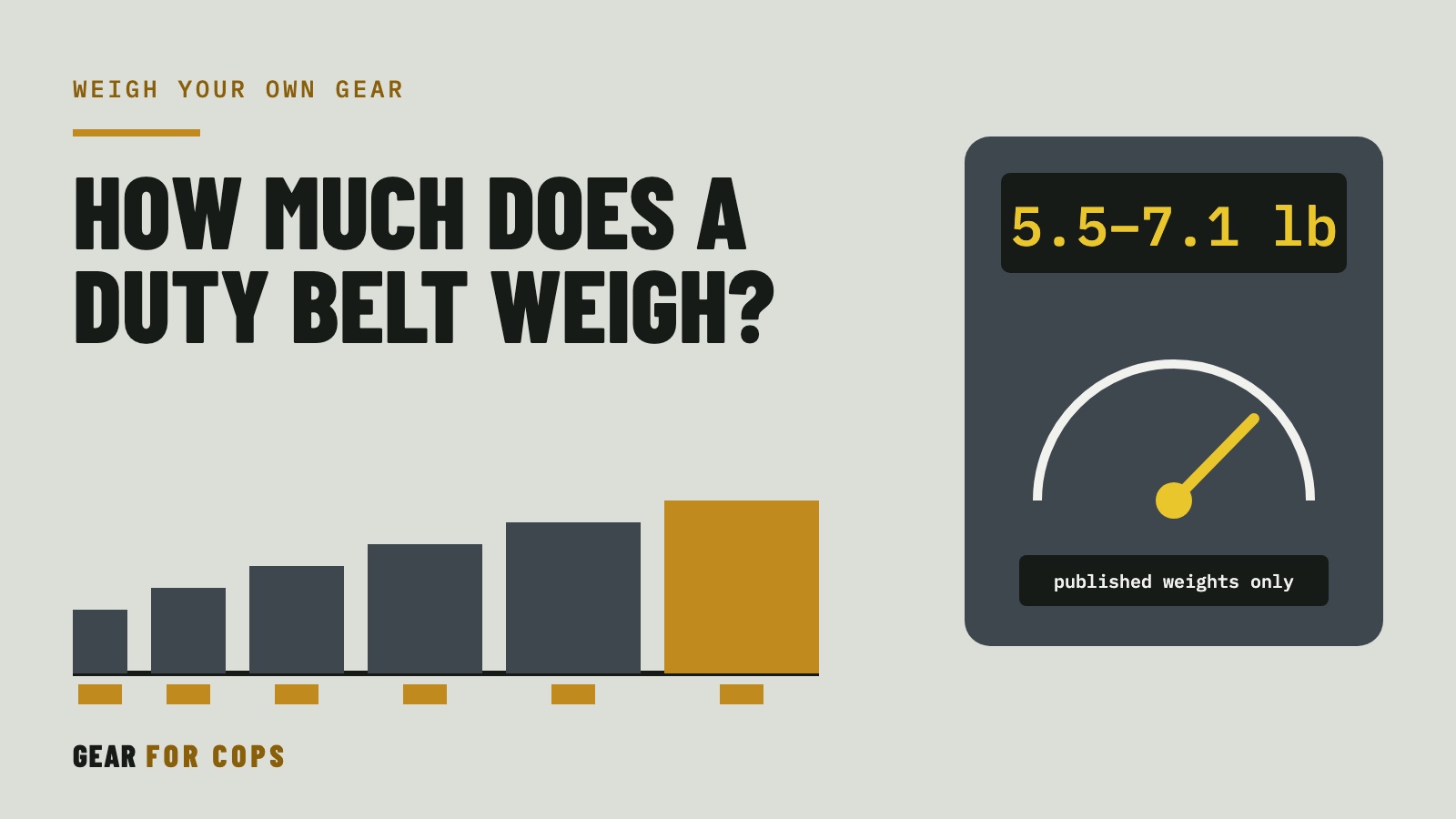
TL;DR: We added up weights that the makers publish for a typical patrol loadout. A light build (Glock 19 Gen5, two loaded spare mags, a weapon light, cuffs, a Motorola APX 6000 radio and a baton) comes to about 5.5 lb. A heavier build with a bigger radio battery, a steel baton, a handheld light and S&W cuffs comes to about 7.1 lb. Those are our sums of maker numbers, not weighed belts. Police1 puts a fully loaded belt at 15 to 25 lb, so the gap is mostly items the makers don’t publish weights for: the belt, holster, pouches, keepers, TASER, OC and the rest. The fix starts with weighing your own gear on a scale. This is a buying and organizing guide, not medical advice. Check your agency’s policy before you change what you carry.
How much does a duty belt weigh?
The honest answer is “it depends on the belt you build,” and the published numbers disagree with each other.
- Police1 (staff article, May 5, 2025): “A fully equipped police duty belt typically weighs between 15 and 25 pounds, depending on the gear required by the department” (Police1).
- University of Wisconsin System news story (Feb. 11, 2019): in a story about a UW-Eau Claire study, the writer describes officers’ equipment as something that “often weighs close to 30 pounds” (UW System). That is the news story’s description, not a measured result from the study.
- Our own addition from maker spec sheets (derived): about 5.5 to 7 lb for the items whose weights are actually published. More on that below.
Those numbers don’t conflict as much as they look. They are counting different things. The Police1 range is a rule-of-thumb for a fully loaded belt. Our number is only what we could source item by item. If you want to know your own belt weight, put it on a scale. That takes two minutes, and it beats every average on this page.
There’s no single “average police duty belt weight” we can responsibly give you. Agencies issue different gear, officers add their own, and nobody publishes a census. What we can do is show how the weight adds up, so you can see where yours comes from.
How we built the weight table
Rules we followed:
- Maker pages only, with the product page or spec sheet linked. Where a number came from a retailer listing, we say so.
- No guessing. When a maker doesn’t publish a weight, the cell says “Not published.” We don’t fill in a typical number.
- Show the config. A pistol “with magazine” and a pistol “unloaded” are different numbers. We print which one the maker’s page gave.
- Derived numbers are labeled. When we subtract or add two maker numbers, the row says “derived.”
- Checked date. Everything below was checked Nov. 12, 2026. Weights can change with a revision, so check the linked page before you buy.
We haven’t weighed any of this ourselves, and we haven’t tested how any of it feels on a belt. See How we pick for our general standards.
The worked weight table
Sidearm, magazines, holster
| Item | Weight as the maker prints it | Config / note | Source |
|---|---|---|---|
| Glock 19 Gen5 | 610 g (21.52 oz) | Without magazine | Glock |
| Glock 19 Gen5 | 670 g (23.63 oz) | With empty magazine | same page |
| Glock 19 Gen5 | 855 g (30.16 oz) | With loaded magazine | same page |
| Glock 17 Gen5 | 630 g (22.22 oz) | Without magazine | Glock |
| Glock 17 Gen5 | 708 g (24.97 oz) | With empty magazine | same page |
| SIG Sauer P320 Full-Size 9mm | 28.3 oz (802.3 g) | “w/ Magazine”; the page doesn’t say loaded or empty | SIG Sauer |
| One spare Glock 19 Gen5 magazine, loaded | 245 g (8.64 oz) | Derived: 855 g loaded pistol minus 610 g pistol without magazine | calculated from the Glock numbers |
| One spare Glock 19 Gen5 magazine, empty | 60 g (2.12 oz) | Derived: 670 g minus 610 g | calculated from the Glock numbers |
| Safariland 6360 ALS/SLS Level III duty holster | Not published | Product page shows features, not weight | Safariland |
The Glock difference is useful. Two spare loaded G19 magazines add about 490 g, or 17.3 oz (derived: 2 x 245 g), which is a bit more than a pound. That figure comes from Glock’s own numbers. Glock’s page lists a standard capacity of 15 rounds, but its weight line just says “with loaded magazine” without a round count, so treat the magazine figures as close, not exact.
Duty holsters are the biggest data gap in this whole article. Most holster pages list retention features and fit charts and skip the weight, and we could not find a Safariland page that prints one for its Level III duty holsters. So the holster is left out of our totals below. If you know a maker that prints it, tell us through the contact page.
Lights
| Item | Weight as the maker prints it | Config / note | Source |
|---|---|---|---|
| Streamlight TLR-1 HL (weapon light) | 4.32 oz (122.5 g) | The page’s spec block | Streamlight |
| Streamlight ProTac 2L-X (handheld) | 3.9 oz (111 g) with CR123A; 4.4 oz (125 g) with the SL-B26 pack | “3.9 oz (111g) with CR123A batteries; 4.4 oz (125g) with SL-B26 battery pack” | Streamlight |
| Streamlight Stinger 2020 (handheld) | 12.30 oz (348.70 g) | Listed as “Weight (Max)”; battery type on the page is the SL-B26 rechargeable pack | Streamlight |
Our lumens guide goes deeper on picking a light by candela and runtime, not by lumens alone. The weight gap matters here: a Stinger 2020 weighs 8.4 oz more than a ProTac 2L-X with CR123A (12.3 minus 3.9, derived).
Restraints, radio, impact tool, OC, TASER
| Item | Weight as the maker prints it | Config / note | Source |
|---|---|---|---|
| Peerless Model 700C chain handcuff, nickel | 10 oz (283 g) | Carbon steel, nickel finish; the page gives one weight with no other note | Peerless |
| Smith & Wesson Model 100-1 handcuff, blue | 11.2 oz | Blued finish; the page gives no other detail on the weight | S&W |
| Motorola APX 6000, radio only | 10.9 oz (309 g) | Without battery | Motorola datasheet |
| APX 6000 IMPRES 2 battery, 3400 mAh | 6.5 oz | Battery alone | same datasheet |
| APX 6000 battery, 4850 mAh | 11.0 oz | Battery alone | same datasheet |
| APX 6000 + 3400 mAh battery | 17.4 oz | Derived: 10.9 + 6.5 | calculated |
| Motorola APX 8000, radio only | 11.25 oz (319 g) | Without battery | Motorola datasheet |
| APX 8000 + 4850 mAh battery | 22.25 oz | Derived: 11.25 + 11.0 | calculated |
| ASP Friction Loc 21″ baton, airweight | 8.9 oz | Maker lists two materials; 7.70″ retracted | ASP |
| ASP Friction Loc 21″ baton, steel | 16.3 oz | Same page | same page |
| SABRE Red MK-4 stream | “3.3 oz” | Container size as printed (“SABRE’s MK-4 3.3 oz Stream”); the page doesn’t say fluid ounces or net weight, so we don’t treat it as a weight | SABRE |
| Axon TASER 10 | Not published | The product page we loaded lists no weight | Axon |
A note on radios: Motorola prints the radio and each battery separately, so the “radio plus battery” totals are our arithmetic. The battery you pick matters. On the APX 6000 sheet, the 4850 mAh battery is 4.5 oz heavier than the 3400 mAh one (11.0 minus 6.5). Whether the longer runtime is worth that is a call for you and your radio shop.
A note on the TASER: the law enforcement TASER 10 page lists no weight on the version we loaded. We would rather print “Not published” than borrow a number from a different model.
Belts and rated loads
Belt weights are rare on maker pages. What you’ll often find instead is a load rating, which is a different number. Kore Essentials’ collection page, for example, lists a 30 lb rating for its 2″ Patrol Duty Belt (checked Nov. 12). That is the maker’s stated capacity, not the weight of the belt, and not a medical or safety recommendation for how much you should carry.
Kore’s same page also lists a 20 lb rating for its 2.25″ duty belt and 10 lb ratings for some of its 1.75″ belts, so ratings differ even inside one brand. For a look at which belts officers named, see Duty belts officers named most.
Adding it up: two example builds
These totals are derived: our own arithmetic on the maker weights above, not a belt we put on a scale. They leave out the belt itself, the holster, keepers, pouches, a TASER, OC, gloves, a tourniquet, a knife and anything else with no published maker weight.
| Item | Light build (oz) | Heavier build (oz) |
|---|---|---|
| Glock 19 Gen5, loaded magazine | 30.16 | 30.16 |
| Two spare loaded mags (derived) | 17.28 | 17.28 |
| Streamlight TLR-1 HL on the pistol | 4.32 | 4.32 |
| Handcuffs | 10.0 (Peerless 700C) | 11.2 (S&W 100-1) |
| Radio with battery (derived) | 17.4 (APX 6000, 3400 mAh) | 22.25 (APX 8000, 4850 mAh) |
| Baton | 8.9 (ASP airweight) | 16.3 (ASP steel) |
| Handheld light | none | 12.3 (Stinger 2020) |
| Subtotal (published items only, derived) | 88.1 oz = about 5.5 lb (2.5 kg) | 113.8 oz = about 7.1 lb (3.2 kg) |
Two things to take from that table.
- Choices inside one category move the total by a pound or more. Between the two builds, the radio swap alone is 4.9 oz, the baton 7.4 oz, and the handheld light is 12.3 oz.
- Published numbers explain only part of a real belt. If the 15 to 25 lb range from Police1 is close to your reality, then roughly 8 to 19.5 lb (15 to 25 lb minus our 5.5 to 7.1 lb subtotals) is in things this table can’t price: the belt, holster, buckles, keepers, pouches, a TASER and cartridges, OC, a tourniquet, gloves, a knife or multitool, and a body camera. Police1’s own list names TASER, OC, gloves and medical gear among the belt items.
That is why we built the worksheet below.
Your worksheet
Print this, weigh each item on a kitchen scale (grams or ounces, not by feel), and add it up. Do it with the items loaded as you carry them.
| Item | Your weight | Maker’s number, if published |
|---|---|---|
| Belt (outer + inner, buckles) | Often not published | |
| Holster | Often not published | |
| Pistol, loaded | See table above | |
| Spare mags + pouch | Mag weights derivable; pouch usually not published | |
| Weapon light (on pistol) | See table above | |
| Handheld light + ring/holder | See table above | |
| Cuffs + case | See table above | |
| Radio + battery + holder | See table above | |
| TASER + cartridges + holster | Not published for TASER 10 | |
| OC + holder | Container size only | |
| Baton + holder | See table above | |
| Tourniquet, gloves, knife, other | Varies | |
| Total |
If you want a second opinion on where the weight sits, check the position of each item, not just the sum. Where the weight sits is a separate question from how much there is. Look at the belt in a mirror and note which items are on which side. That is a layout question, and we can’t rank layouts for you.
What the research says (and doesn’t)
We’re not doctors and we aren’t giving medical advice. If you have back, hip or leg pain, see a clinician. Here is what the sources we read say.
- NIOSH (CDC) Health Hazard Evaluation, January 2020. NIOSH looked at low back pain and duty equipment wear configurations in a police department of 77 sworn officers, and found that nearly half of the officers reported low back pain in the previous 3 months. It wrote: “Because of the lack of clear departmental policy on required and (approved) optional equipment, many officers may be carrying unnecessary weight.” Its recommendations included a clear policy on required versus optional equipment and a list of assist devices “such as suspenders or vests, which other officers have used and found helpful” (NIOSH HHE 2017-0049-3367). That is one department, so don’t read it as a national finding.
- UW-Eau Claire study, as reported by the University of Wisconsin System. The story says officers who “carry most of their equipment… on vests rather than duty belts experience significantly less hip and lower-back pain, the study found.” The faculty lead is quoted: “While the vests weigh more, the weight is more evenly distributed so there is less strain on the hips and lower back” (UW System). This is a university news story about the study, not the paper itself.
- 2023 paper led by George Mason University researchers. The authors open with: “Sixty percent of all law enforcement officers (LEOs) experience low back pain (LBP), with the LEO duty belt (LEODB) commonly reported to be a contributing factor” (J. Funct. Morphol. Kinesiol., 2023). The study itself looked at muscle activation during hip hinging movements in young, healthy adults, not at officers on patrol.
What those sources don’t say: that a specific weight causes injury, that any one setup is right for you, or that vests beat belts for every body and every job. The NIOSH report itself says “data are insufficient about using external vests versus standard leather utility belts to reduce low back pain.” Treat this as a reason to look at your own setup, not as a verdict.
Load-bearing vests and suspenders: what they are
These are two common ways officers shift where the weight rides. We describe them. We don’t claim either one is better for your body.
- Duty belt suspenders are adjustable shoulder straps that attach to the belt so the shoulders carry part of the load. One seller, Holdup Suspender Company, describes them as “adjustable shoulder straps that carry part of the weight of a loaded equipment belt, shifting some load from the waist and hips to the shoulders and upper torso” (suspenders.com). That is a seller’s description, not a study. We couldn’t find a maker page with a published suspender weight.
- Load-bearing vests (external vest carriers) are outer carriers that hold armor and have places to mount gear. Police1’s FAQ defines a police load-bearing vest as “an external carrier that redistributes duty-gear weight from the hips and lower back to the torso and shoulders,” with common items including spare magazines, handcuffs, OC spray, a radio with mic, a flashlight, a body-camera mount and an IFAK (Police1, Sept. 22, 2025). It names carriers from BlueStone Safety, Armor Express, Safariland, Safe Life Defense and Point Blank. We haven’t compared them.
Things to check before you try either, which come from common sense and not from a study:
- Agency policy. Some agencies require specific uniform configurations. NIOSH recommended that the department it studied “Issue a policy that states when a medical necessity waiver is required to obtain devices, such as suspenders,” so ask how yours handles it.
- Armor compatibility. An external carrier has to fit your armor. See our guide to checking whether body armor is NIJ certified before you buy or swap panels.
- Vehicle fit. Seat belt, seat bolsters and the laptop mount all interact with where gear sits.
- Heat and weight. A vest adds fabric and puts weight on the torso. The UW quote above says vests can weigh more in total.
Ways to cut duty belt weight
Our advice is first, with numbers from the tables where they exist. These are labeled as opinion.
- Weigh it first. You can’t cut what you haven’t measured. Use the worksheet.
- Choose lighter variants where the function is the same. From maker numbers on this page: the airweight ASP baton is 7.4 oz lighter than the steel one (8.9 vs 16.3). A ProTac 2L-X is 8.4 oz lighter than a Stinger 2020 (3.9 vs 12.3). A 3400 mAh APX battery is 4.5 oz lighter than the 4850 mAh one (6.5 vs 11.0). All three swaps together would be 20.3 oz, about 1.3 lb. Each swap changes something else: length and feel, runtime, or battery life. Decide with your trainer and your shift length.
- Drop the duplicates. Two handheld lights, two cuff cases and a multitool you never open all add up. NIOSH raised the same issue: officers “carrying unneeded equipment because of the lack of clear guidance.”
- Count the weapon light. A light like the TLR-1 HL adds 4.32 oz to the pistol. If your agency issues one, that is policy; if it’s optional, talk it over with your range staff.
- Move what you can off the belt. Items like a radio or mag pouches can live on a vest or carrier in some agencies. See the section above.
- Check the belt’s stated load rating, not just the weight of the belt. Kore lists 30 lb for its 2″ patrol belt. If the maker’s rating is below what you carry, that’s worth a phone call.
- Look at balance. A belt with weight piled on one side is a layout problem, and often fixable with a few keeper and pouch moves.
- Re-weigh after each change. You’ll see what mattered.
For ideas on what to buy once you’ve sorted the loadout, our Duty belts page and Lights page hold what we’ve collected so far.
What agencies typically regulate
We don’t have a survey of agency policies, and we found no published maximum duty-belt weight. What we know from our reading:
- NIOSH’s department-level review described the lack of a written list of required versus optional equipment as a problem, and recommended creating one.
- Many agencies issue a uniform and equipment list. Optional items and alternative configurations (for example, suspenders or an external carrier) may need approval.
So: check your policy. Ask your supervisor or your equipment officer before you change anything, especially anything that holds a weapon, a radio or a less-lethal tool. This article is not your agency’s policy.
How we chose what to include
We picked categories from a typical patrol loadout as listed by Police1 and added the specific models that had published weights we could link. We didn’t pick “best” items. A model appearing here means a maker published a number, not that we recommend it. We have no affiliate links on this site today. For our rules on sourcing, see How we pick and our officer picks. If you’re buying for a new recruit, the police academy gear list covers what to get first, and gifts for police officers has ideas for family.
FAQ
How much does a police duty belt weigh?
Police1 says a fully equipped one “typically weighs between 15 and 25 pounds,” depending on department requirements. Weights vary because agencies and officers carry different gear. The maker-published weights we could source for a sidearm, two spare mags, lights, cuffs, radio and baton add up to about 5.5 to 7 lb by our arithmetic, and the rest comes from items with no published weight, including the belt and holster.
What is the average police duty belt weight?
We don’t have a sourced national average. The best figure we can attribute is Police1’s 15 to 25 lb range for a fully equipped belt. Weigh your own.
How heavy is a Glock 19 loaded?
Glock lists the Gen5 G19 at 855 g (30.16 oz) with a loaded magazine, 670 g with an empty magazine and 610 g without a magazine. Its standard magazine holds 15 rounds.
Do duty belt suspenders help?
They shift part of the belt load to the shoulders. NIOSH, in one department’s review, listed suspenders and vests among options for officers to try, and recommended the department make clear when a medical necessity waiver is needed. We found no sourced study on suspenders alone, and we can’t say they will help you. This is not medical advice; if you have pain, see a clinician.
Is a load-bearing vest better than a duty belt?
A University of Wisconsin System story reports a UW-Eau Claire study in which officers carrying most gear on vests had significantly less hip and lower-back pain. NIOSH says “data are insufficient” on external vests versus standard leather belts for low back pain. We can’t tell you which is right for you. Your agency’s policy and your own fit matter.
How can I reduce my duty belt weight?
Weigh each item, swap to lighter variants where the function is the same, drop duplicates, balance the belt, and consider moving items off the belt where your agency allows. See the numbered list above.
Is there a maximum duty belt weight?
We found no published maximum from the sources we read. Makers print load ratings for their belts (for example, 30 lb for Kore’s 2″ patrol duty belt), and individual agencies set their own equipment rules. Check your policy.
Why don’t maker pages list holster, belt or TASER weights?
We can’t speak for them. In our checks, many holster and belt pages list features and sizes only, and the Axon TASER 10 page lists no weight. If you find a maker that does publish these, send it to us.
Does duty belt weight cause back pain?
We aren’t going to make that claim. Research reports, including a 2023 paper that notes duty belts are “commonly reported to be a contributing factor” to low back pain, are about association and reports. This is not medical advice. For your own pain, see a clinician.
Keep going
Choosing a belt? Start with Duty belts officers named most, then browse Duty belts. Standing all day is its own load. See police boots for standing all day. Wearing armor too? Read how to check body armor is NIJ certified. For off-duty carry, see LEOSA explained. Gift season? What to get your squad for Christmas. More guides live in buyer guides and Duty belts.
Sources
All checked Nov. 12, 2026 unless noted.
- Glock G19 Gen5 and Glock G17 Gen5. Weights without magazine, with empty magazine and with loaded magazine.
- SIG Sauer P320 Full-Size. 28.3 oz with magazine.
- Streamlight TLR-1 HL. 4.32 oz.
- Streamlight ProTac 2L-X and Stinger 2020. 2L-X 3.9 oz (CR123A) / 4.4 oz (SL-B26); Stinger 2020 12.30 oz “Weight (Max)” on SL-B26.
- Peerless Model 700C and Smith & Wesson Model 100-1. 10 oz / 283 g and 11.2 oz.
- Motorola APX 6000 datasheet and APX 8000 datasheet. Radio and battery weights listed separately.
- ASP Friction Loc 21″ baton. Airweight 8.9 oz, steel 16.3 oz.
- Safariland 6360 product page. No weight published.
- Kore Essentials duty belt collection. 30 lb rating for the 2″ Patrol Duty Belt; 20 lb for the 2.25″ duty belt.
- SABRE: Police pepper spray, what law enforcement actually carries. Container sizes as printed.
- Axon TASER 10. No weight on the page.
- NIOSH Health Hazard Evaluation Report 2017-0049-3367, January 2020. Evaluation of Low Back Pain and Duty Equipment Wear Configurations in Police Officers.
- University of Wisconsin System: UW-Eau Claire research aims to improve police officers’ health, quality of life, Feb. 11, 2019. University news story; quote from faculty lead Dr. Jeff Janot.
- Police1: What’s on a police officer’s duty belt, May 5, 2025. 15 to 25 lb range, item list.
- Police1: Police load bearing vest FAQ guide, Sept. 22, 2025.
- Effect of the Law Enforcement Duty Belt on Muscle Activation during Hip Hinging Movements in Young, Healthy Adults, Journal of Functional Morphology and Kinesiology, July 2023. 24 young, healthy, recreationally active adults.
- Holdup Suspender Company (suspenders.com): Adjustable Duty Belt Suspenders For Duty Officers. Seller page, opened in full Nov. 12, 2026.
- Autocomplete phrasing check: Google suggest queries run Nov. 12, 2026 for “duty belt weight” and “average duty belt weight.”