We may earn a commission if you buy through links on this page. It doesn’t change our picks or the data. Full disclosure.
TL;DR: OSHA and NIOSH, the two U.S. agencies that publish cold-stress guidance for workers, say the same basic things: wear layers of loose clothing, keep the inner layer from holding moisture, add a layer that insulates even when damp, finish with a layer that blocks wind and rain, cover your head, hands and feet, and carry spares. OSHA’s quick card also lists “Dressing improperly, wet clothing/skin, and exhaustion” as risk factors. Patrol adds three twists: you go from a heated car to a freezing sidewalk in seconds, your belt and vest limit what you can wear, and your agency decides what is allowed on the uniform. This guide builds a layer system around those facts, gives examples with maker-published specs and prices checked Nov. 12, 2026, and lists what to keep in the car. We haven’t tested any product. Health statements come from OSHA, NIOSH and the National Weather Service, and this is not medical advice. Check your agency’s uniform policy before you buy.
In this guide
- Why patrol is a different cold problem
- What the official guidance says
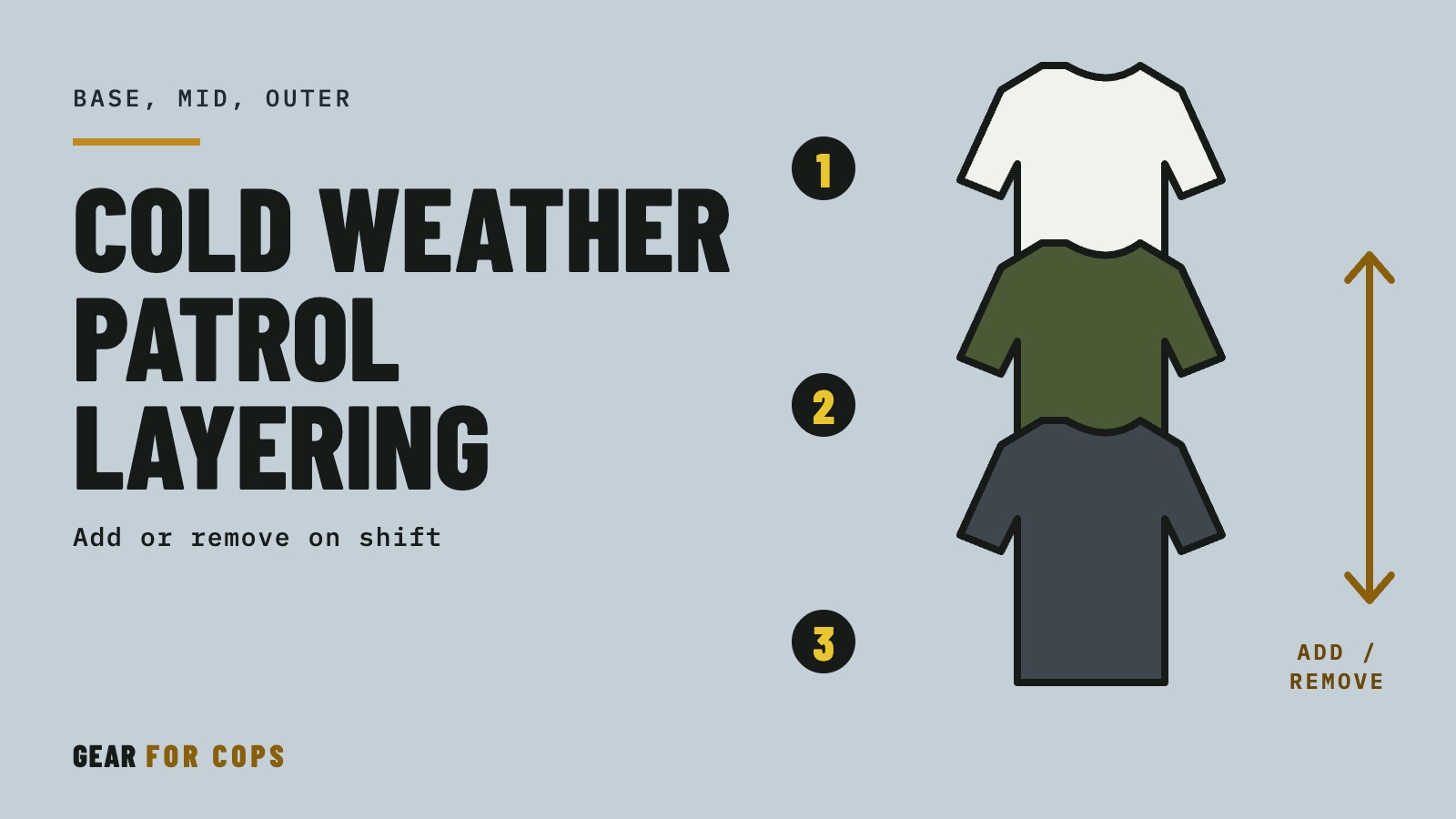
- The layer system at a glance
- Base layer: the one you don’t see
- Mid layer: insulation you can take off
- Outer layer: wind, rain and what your agency allows
- Extremities: feet, hands and head
- Cruiser versus foot post
- Wind chill and when to be more careful
- Warning signs: know them and watch your partner
- Uniform policy: the caution that decides what you can buy
- A cold-shift checklist
- Shopping smart
- How we chose what to include
- FAQ
- Keep going
- Sources
Why patrol is a different cold problem
A construction worker in the cold stays outside. An officer on patrol does something harder: you move between a heated cabin and an outdoor scene dozens of times a shift, and the work swings from sitting to sprinting.
That matters because of what OSHA says about moisture. On its winter weather preparedness page, OSHA tells workers to “Stay dry in the cold because moisture or dampness, e.g. from sweating, can increase the rate of heat loss.” In plain terms, if you overdress in the car, break a sweat on a foot pursuit and then stand still at a scene, the sweat works against you.
Our observation, not a cited finding: most cold problems on patrol aren’t about having too little clothing. They come from having the wrong clothing at the wrong moment. A heavy coat that is perfect for a traffic stop is a sweat machine in a stairwell, and a thin one is fine for a quick call but not for forty minutes on a perimeter.
So the goal of layering isn’t maximum warmth. It’s adjustability, and that comes from several thinner layers you can add and remove.
What the official guidance says
We read the primary sources so you don’t have to guess where the layering rules come from. All quotes are from the pages as we read them on Nov. 12, 2026.
OSHA winter weather preparedness page. Under “Dressing Properly for the Cold,” OSHA says to “Wear at least three layers of loose fitting clothing. Layering provides better insulation.” It then describes each layer:
- Inner: “An inner layer of wool, silk or synthetic (polypropylene) to keep moisture away from the body.”
- Middle: “A middle layer of wool or synthetic to provide insulation even when wet.”
- Outer: “An outer wind and rain protection layer that allows some ventilation to prevent overheating.”
It adds: “Tight clothing reduces blood circulation.” For the head, “Hat that will cover your ears as well.” For hands, “Insulated gloves (water resistant if necessary), to protect the hands.” For feet, “Insulated and waterproof boots to protect the feet.” And: “Keep extra clothing (including underwear) handy in case you get wet and need to change.”
OSHA quick card, “Protecting Workers from Cold Stress” (OSHA 3156-02R 2014). It lists “Layers of loose-fitting, insulating clothes,” an “Insulated jacket, gloves, and a hat (waterproof, if necessary)” and “Insulated and waterproof boots.” It also says “Know the symptoms; monitor yourself and co-workers.”
NIOSH cold stress page (the page shows July 14, 2026). NIOSH says: “Wear several layers of loose clothing for better insulation.” It warns: “Some clothing may restrict movement, which could be dangerous.” On the head: “Wear a hat. Hats reduce body heat escaping from your head.” And: “Make sure to protect the ears, face, hands, and feet.” Footwear: “Boots should be waterproof and insulated.” Spares: “Carry extra socks, gloves, hat, jacket, clothes, and blankets.”
What none of them do: name a brand, a fabric weight or a temperature at which to switch. They don’t address body armor, duty belts or uniform rules. That part is up to you and your agency, and the rest of this guide fills the gap with clearly marked opinion.
The layer system at a glance
| Layer | Job | Material guidance (source) | Patrol note (our opinion) |
|---|---|---|---|
| Base | Keep moisture off the skin | “wool, silk or synthetic (polypropylene)” (OSHA) | Thin and snug. It sits under your armor carrier or vest, so avoid bulk and rough seams |
| Mid | Trap warm air, insulate even if damp | “wool or synthetic” (OSHA) | Fleece or a light insulated vest are common; pick one you can take off in a car |
| Outer | Block wind and rain, allow ventilation | “wind and rain protection layer that allows some ventilation” (OSHA) | Your agency may issue it or limit your options |
| Head, hands, feet | Protect extremities | hat covering ears; insulated gloves; insulated, waterproof boots (OSHA, NIOSH) | Check what the uniform policy allows |
| Spares | Swap out wet gear | “extra socks, gloves, hat, jacket, clothes, and blankets” (NIOSH) | Keep in the car, in a bag |
The “Patrol note” column is ours. The material column is the agencies’ wording.
Base layer: the one you don’t see
The base layer’s job is to keep moisture away from the skin. OSHA says wool, silk or synthetic. The OSHA page contrasts these with cotton, saying it wants “inner layers of clothing that will hold more body heat than cotton.” We read that as: skip the cotton undershirt on cold shifts. It’s our reading of the page, not a lab result.
What to look for, in our judgment:
- Fit. Snug but not tight. OSHA says “Tight clothing reduces blood circulation.”
- Weight. A midweight top for most winter shifts, lighter for mild days. Makers publish fabric weights in grams per square meter. Smartwool lists its Classic Thermal Merino line as “Midweight: 250g/m2” and “100% Merino Wool Fabric.” That is a maker’s page, and it is one example, not a pick.
- Seams and neckline. Armor carriers and duty vests rub. Flat seams matter more than they sound.
- Odor and washing. Merino and synthetics both come with claims here. We haven’t tested them.
- Price. Smartwool’s Classic Thermal bottoms showed “$69.00 – $125.00” on Nov. 12, 2026, with the price depending on the variant chosen. Synthetic base layers from other makers can cost less. We didn’t survey them.
A base layer doesn’t have to be a brand name. It has to be dry, snug and not cotton.
Mid layer: insulation you can take off
OSHA’s description is “A middle layer of wool or synthetic to provide insulation even when wet.” The reason for the “even when wet” clause is that you will get damp: from sweat, from snow melting on your sleeves, or from a call in the rain.
Common choices are fleece, a light insulated vest or a softshell. We don’t have a sourced ranking among them. What we’d consider:
- Can you remove it quickly in a car? A zip-front fleece comes off in the seat. A pullover with a bulky neck is slower.
- Does it bunch under your outer layer or carrier? NIOSH warns that “Some clothing may restrict movement, which could be dangerous.” Test your draw, your reach for the radio and your ability to turn your head while seated in the car.
- Is it allowed? A mid layer that shows may count as a uniform item. See the policy section.
If you have to choose one place to add warmth, a mid layer you can add and remove is the most flexible.
Outer layer: wind, rain and what your agency allows
OSHA’s outer layer is “wind and rain protection” that “allows some ventilation to prevent overheating.” That is the opposite of a sealed plastic coat. Ventilation is the point.
Many officers wear issued jackets, so the outer layer is often a question of policy, not preference. If you are free to choose, here is an example of what a maker publishes for a duty parka.
5.11 Bristol Parka (example). The maker’s page lists a “10K/6K waterproof/breathable rating,” an outer jacket of “100% nylon plain weave hardshell 2.5L, 5.0-oz., BBP, DWR finish,” and an inner jacket of “100% polyester plain weave face with micro fleece backer 3L softshell, 7.3-oz., DWR finish,” which is removable. The hood is detachable. On Nov. 12, 2026 the page showed a sale price of $262.50 against a regular price of $375. Those are the maker’s statements and prices. We haven’t tested the parka, and the page doesn’t give a temperature rating.
What to take from the example is how to read a spec sheet:
- The waterproof/breathable rating (10K/6K here) is the maker’s number. It tells you roughly how much water and vapor the fabric handles, but it doesn’t tell you the warmth.
- “DWR” is a water-repellent finish. It wears off, and it’s a coating, not a membrane.
- Removable liners let you change the jacket across seasons: shell alone in a cold rain, shell plus liner in a hard freeze.
Warmth comes from insulation and air, not from the shell. If a listing is long on waterproofing and short on insulation, expect to add your own mid layer.
Extremities: feet, hands and head
NIOSH and OSHA both single out the same body parts. So do we, because patrol officers lose finger dexterity and foot comfort first.
Feet. OSHA says “Insulated and waterproof boots.” The OSHA quick card describes trench foot as a “Non-freezing injury to the foot, caused by lengthy exposure to wet and cold environment,” and says it “Can occur at air temperature as high as 60°F, if feet are constantly wet.” Wet feet are a medical risk, not just a comfort issue.
Boot choice is its own subject, and our police boots for standing all day guide covers it, including an insulated 5.11 A.T.A.C. 2.0 8″ model and a Rocky Alpha Force Side Zip 400G, with the maker-published specs. Fit the boot with the sock thickness you’ll really wear, as that guide explains.
Socks. A thick sock in a boot fitted for a thin one makes a tight boot, and tight boots cut circulation. Darn Tough’s T4021 Boot Midweight Tactical sock is an example of a maker-published fiber blend: “62% Merino Wool, 36% Nylon, 2% Lycra Spandex,” with the maker’s “Unconditionally Guaranteed for Life” return policy. A three-pack showed $90 on Nov. 12, 2026. Keep a spare pair in the car.
Hands. NIOSH says to protect the hands, and OSHA says “Insulated gloves (water resistant if necessary).” Our police gloves guide covers cut levels and sizing. For winter, 5.11 publishes two examples: the Patrol CR (PrimaLoft Gold 40 g on the back of the hand, a palm cut-resistance liner, touchscreen compatible, $60) and the Adiron (PrimaLoft Gold 170 g back and 100 g palm, Tac Dry waterproof/breathable, $60). Both are maker statements. Thicker gloves cost feel, so many officers keep a thin pair for fine work.
Head. NIOSH: “Wear a hat. Hats reduce body heat escaping from your head.” OSHA: “Hat that will cover your ears as well.” Agencies often control hats more tightly than other items, so check before you buy.
Face and neck. NIOSH names the face and ears. A neck gaiter or balaclava is a common answer. We didn’t find a sourced evaluation, and agencies vary on whether they’re allowed.
Cruiser versus foot post
The right system depends on how much time you spend outside the car. Here is how we’d think about it. It is our opinion, built on the agency guidance above.
| Situation | Main risk | Layering approach (our opinion) |
|---|---|---|
| Mostly in the car, short stops | Overheating in the car, chill at stops | Lighter mid layer, outer layer you can shed in the seat or unzip. Gloves and hat within reach, not in the trunk |
| Long stops: crash scenes, perimeters | Standing still after warming up | Add insulation before you get out. Spare gloves and dry socks in the car |
| Foot post or bike post | Constant wind, long exposure | Full system with a ventilated outer layer; plan breaks in a warm place |
| Overnight or wet weather | Wet clothing, fatigue | Waterproof outer layer; spare base layer and socks; hot drink if available |
In the car. The cabin is warm, and wearing your full outer system while driving is how you start a sweat. Take the outer layer off or open it. The risk comes when you step out. Make a habit of putting the layer on before you open the door, not after.
On the post. OSHA says employers should “Gradually introduce workers to the cold; monitor workers; schedule breaks in warm areas.” Whether your agency does that is policy, not gear. The practical part is that on a foot post you can’t avoid the cold, so you need the whole system plus a break plan.
Vehicle supplies. Ready.gov’s winter-weather page, last updated Nov. 3, 2026, says a vehicle kit should “Include jumper cables, sand, a flashlight, warm clothes, blankets, bottled water and non-perishable snacks,” and “Keep a full tank of gas.” That is a public-safety page for the general public, but the list fits a cruiser too. Your fleet rules may dictate what you can store. See our patrol bag guide for how to pack a bag around it.
Wind chill and when to be more careful
Wind chill is a measure of how cold you feel, and it matters when you stand in the wind. The National Weather Service says “The wind chill temperature is how cold people and animals feel when outside.” Its example: with an air temperature of 0°F and a 15 mph wind, the wind chill is -19°F, and “exposed skin can freeze in 30 minutes.” That 30-minute figure belongs to that example and isn’t a general rule.
Frostbite above freezing: the two agencies disagree. The OSHA quick card (OSHA 3156-02R, 2014) says frostbite “Can occur at temperatures above freezing, due to wind chill.” The National Weather Service, which publishes the U.S. wind chill index, answers the question directly in its FAQ: “The air temperature has to be BELOW freezing for frostbite to develop on exposed skin. Wind chill can NOT bring the temperature to below freezing for humans and animals when the thermometer says it is above freezing, so you will not get frostbite; however, you might get hypothermia from exposure to cold.” The same NWS page explains that wind speeds heat loss, and that an inanimate object “will NOT cool below the actual air temperature.”
How we read the two, labeled as our reading: the NWS explanation is the more specific one. Wind chill describes how fast skin loses heat, not a temperature the skin can fall below, so dry exposed skin shouldn’t freeze while the air is above 32°F. The OSHA card’s one-line version is a simplified warning on a 2014 card. Neither source says the cold is harmless above freezing. NWS warns of hypothermia, and OSHA’s card says trench foot “Can occur at air temperature as high as 60°F, if feet are constantly wet.” Our plan: treat any sub-freezing wind as a hazard to exposed skin, cover your face, ears and hands, and keep your feet dry at any temperature. This is not medical advice.
Warning signs: know them and watch your partner
This section is information, not medical advice. If you or someone else shows signs, follow your agency’s protocol and call for medical help.
NIOSH’s page on cold-related illnesses (dated Mar. 3, 2026) lists:
- Hypothermia, early: “Shivering,” “Fatigue,” “Loss of coordination,” “Confusion and disorientation.” Late: “No shivering,” “Blue skin,” “Dilated pupils,” “Slowed pulse and breathing,” “Loss of consciousness.”
- Frostbite: “Numbness,” “Tingling or stinging,” “Aching,” and bluish or pale, waxy skin. NIOSH says the risk is increased in “Workers with reduced blood circulation” and “Workers who are not dressed properly.”
- Trench foot: “Reddening of the skin,” “Numbness or tingling pain,” “Swelling” and “Blisters or ulcers.”
OSHA’s card gives these first-aid steps for hypothermia: “Call 911 immediately in an emergency,” “Move the worker to a warm place,” “Change to dry clothes,” and “Cover the body (including the head and neck) with blankets.” For frostbite it says “Do not rub the frostbitten area” and “Do not try to rewarm the area unless directed by medical personnel.”
A cold, tired officer makes bad decisions, and shivering that stops is not a sign of getting better: it’s listed by OSHA as a moderate-to-severe symptom. Watch your partner and let them watch you.
Uniform policy: the caution that decides what you can buy
Everything above is gear advice. Policy decides what you may wear.
- Lincoln (Nebraska) Police Department policy 1450: “Only issued and/or authorized apparel, uniform equipment, or accessories are to be worn or used.” Deviations from uniform specifications need the chief’s approval, except that division heads can make long-term exceptions for special assignments and commanding officers or unit managers can make short-term exceptions for special purposes.
- Battle Creek (Michigan) Police Department policy 1025: its section on unauthorized uniforms, equipment and accessories says members “may not wear any uniform item, accessory or attachment unless specifically authorized by the Chief of Police or the authorized designee.” It also sets the season: “The winter uniform shall be worn from October 15th through April 14th of each year.”
The Lincoln policy covers uniforms and equipment in general, not winter gear specifically. Battle Creek’s is the one example here with a winter date. The common thread is that your agency, not the maker or this site, decides. Before you spend money:
- Ask whether a winter jacket, hat, gloves, neck gear and base layers are issued or allowed.
- Ask about colors, logos and visible layers. A fleece that shows at the collar may or may not be allowed.
- Ask whether weather or date triggers a change. Some agencies move to a winter uniform on a date (Battle Creek’s is Oct. 15) or by order.
- Ask whether anything affects your armor or the placement of insignia and name tags.
Armor fit is a separate matter. Don’t change how your armor sits to make room for layers. Check the maker’s fit instructions, and see how to check body armor against the NIJ list.
A cold-shift checklist
This is our list, not a standard. Cross out whatever your agency doesn’t allow.
On you:
- Snug base layer (top, and bottoms if cold enough), not cotton
- Mid layer you can remove in the car
- Outer layer with ventilation
- Insulated, waterproof boots and socks fitted for them
- Gloves, plus a thin pair for fine work
- Hat that covers the ears; neck or face cover if allowed
In the car:
- Spare socks, gloves and hat (NIOSH lists “extra socks, gloves, hat, jacket, clothes, and blankets”)
- Dry base layer
- Blanket
- Water and snacks (Ready.gov)
- Flashlight (see our lumens guide)
- Hand warmers or similar, if your agency allows
Habits:
- Pre-warm the car before a long stop, then dress before you get out.
- Vent before you sweat.
- Change out of wet gear as soon as you can.
- Check your partner.
Shopping smart
If you are buying for yourself or a squad, a few notes.
- Buy the piece that fills your biggest gap. For many officers that’s a base layer or good socks, which cost less than a jacket.
- Check fit with your belt and vest. Try it on over the carrier if you can.
- Watch the dates. Winter pieces go on sale after the holidays, and our law enforcement discounts page lists programs that may apply.
- Gift ideas. Socks, base layers and gloves are practical gifts. See gifts for police officers, what to get your squad for Christmas and police academy graduation gifts.
- Recruits. The department may issue most of this. Our police academy gear list explains what to wait on.
- Heavy belts. Cold gear adds bulk around a loaded belt. Our duty belt weight guide shows what a belt weighs by item, and duty belts officers named most covers the belts.
How we chose what to include
We built the layering rules from OSHA, NIOSH, the National Weather Service and Ready.gov, and we quote them where we make a health or safety statement. We chose maker examples that publish fiber content, fabric weight, insulation grams or waterproof ratings on the page, and we report only those numbers. We didn’t rank, we didn’t test and we didn’t use officer votes. Anything not quoted from a source is labeled as our opinion. See how we pick for our standards and the Cold weather category for more gear.
FAQ
What are the three layers for cold weather?
OSHA lists an inner layer to keep moisture away from the body, a middle layer for insulation, and an outer layer for wind and rain protection that allows some ventilation.
What should a police base layer be made of?
OSHA says “wool, silk or synthetic (polypropylene),” and contrasts it with cotton. Example: Smartwool lists its Classic Thermal Merino at 100% Merino, 250 g/m2.
Why avoid cotton in the cold?
OSHA’s page contrasts cotton with inner layers that “hold more body heat.” Cotton holds moisture, and moisture increases heat loss, which OSHA also says.
How do I stay warm in a patrol car without sweating?
Take off or open the outer layer while driving and put it on before you get out. That’s our practice tip, built on OSHA’s point that sweat “can increase the rate of heat loss.”
What should I keep in the car for winter?
NIOSH says “Carry extra socks, gloves, hat, jacket, clothes, and blankets.” Ready.gov adds jumper cables, sand, a flashlight, water and snacks, and a full tank of gas.
Are insulated boots necessary?
OSHA and NIOSH both say boots should be insulated and waterproof. Our boots guide covers specific models.
What are the warning signs of hypothermia?
NIOSH lists shivering, fatigue, loss of coordination and confusion early, and no shivering, blue skin and slowed pulse and breathing late. Call for medical help; this is not medical advice.
Can I wear my own jacket or hat on duty?
Only if your agency allows it. Lincoln’s policy, for example, says only “issued and/or authorized” equipment is to be worn or used. Ask your supervisor.
Does wind chill really matter?
Yes for exposed skin. The NWS example: 0°F with a 15 mph wind gives a wind chill of -19°F, and exposed skin can freeze in 30 minutes.
Can you get frostbite above freezing?
The NWS says no: “The air temperature has to be BELOW freezing for frostbite to develop on exposed skin.” OSHA’s 2014 quick card says frostbite “Can occur at temperatures above freezing, due to wind chill.” We explain the difference in the wind chill section. Either way, hypothermia and trench foot can happen above freezing. Not medical advice.
Do base layers go under body armor?
Many do, but fit depends on your armor and your agency. Follow the armor maker’s instructions and agency policy, and don’t alter how the armor sits.
Keep going
See the Cold weather, Boots, Gloves, Bags and Armor categories, and officer picks. Off duty or retired: LEOSA explained.
Sources
All checked Nov. 12, 2026.
- OSHA: Winter weather preparedness. “Dressing Properly for the Cold.” No date shown on the page.
- OSHA Quick Card: Protecting Workers from Cold Stress (OSHA 3156-02R 2014).
- NIOSH: Cold stress. Page shows July 14, 2026.
- NIOSH: Cold-related illnesses in workers. Page dated Mar. 3, 2026.
- National Weather Service: Cold and wind chill chart.
- Ready.gov: Winter weather. Last updated 11/03/2026.
- Smartwool: Men’s Classic Thermal Merino Base Layer Bottom. 100% Merino, 250 g/m2, price range.
- Darn Tough: T4021 Boot Midweight Tactical 3 Pack. Fiber blend, guarantee, price.
- 5.11 Bristol Parka. Shell and liner fabrics, waterproof/breathable rating, price.
- 5.11 Patrol CR PrimaLoft Insulated Glove and 5.11 Adiron PrimaLoft Insulated Glove.
- Lincoln Police Department policy 1450 and Battle Creek Police Department policy 1025.