We may earn a commission if you buy through links on this page. It doesn’t change our picks or the data. Full disclosure.
TL;DR: A patrol bag is a mobile locker. The right one depends on where it rides (trunk, passenger seat or your back), what you will actually put in it, and how well it keeps small things findable at 0300. We read four product pages and found the numbers officers should compare: capacity in liters, weight, outside dimensions, fabric and how the bag attaches. The four bags we looked at hold between 30 and 40 liters and weigh between 3.3 and 3.85 lb where the maker publishes a weight. Fabric ranged from 600D polyester to 1050D nylon, and none of the four product descriptions we read says Cordura. Pack by weight and by what could go bad in a hot or frozen trunk. Check your agency policy before you carry anything personal into the car. We haven’t tested any bag here. Specs and prices are from the product pages, checked Nov. 12, 2026.
In this guide
- What a patrol bag is for
- Where it rides: trunk, passenger seat or your back
- Size: liters, inches and why they don’t match
- Fabric: denier, nylon, polyester and the word “Cordura”
- Organization and features that matter on a shift
- Four example bags, with maker-published numbers
- What officers pack: a checklist
- Keeping the bag organized
- Policy and security
- What we’d do first (our opinion)
- How we chose what to include
- FAQ
- Keep going
- Sources
What a patrol bag is for
A patrol bag solves one problem: the stuff you need twice a month is not the stuff you need every call. It is the second tier of your loadout. Your belt and vest carry what you need in the next ten seconds. The bag carries what you need in the next ten minutes, or the next ten hours.
Tim Dees, who wrote Police1’s piece on the subject, put it this way: “Officers build them one call at a time.” That matches how most bags get packed. Something goes wrong on a shift, you don’t have the right tool, and the next day it is in the bag. The result is that two officers in the same squad can carry very different bags and both be right.
We looked at this from the buyer’s side. If you are choosing a bag, you want to know four things before you read a review:
- How big is it, measured the way the maker measures it?
- How heavy is it empty? You will carry it loaded.
- What is it made of, in plain terms?
- How does it sit in your vehicle, and will it stay put?
The rest of this guide is those four questions, then what to pack, then four example bags with the maker’s own numbers.
Where it rides: trunk, passenger seat or your back
Before size, decide where the bag lives. The three common answers give you three different bags.
Trunk. A trunk bag can be big and boxy because it never touches your shoulder for more than a short walk. It needs sturdy handles, a stiff bottom and a lid that closes even when the bag is overfilled. Dividers help, because a trunk is where things slide around. The weak point is access: you stop, get out, open the trunk, and dig. Things you need fast don’t belong there.
Passenger seat or front cab. A seat bag puts your admin gear, spare batteries and paperwork within reach. It needs a way to stay in place when you brake hard. The Ultimate Patrol Bag page on Atomic Defense’s store, for example, lists “Removable shoulder straps that secure to the passenger seat.” 5.11 describes its Basic Patrol Bag as “a readiness-optimized storage solution for trunk, cab, or even passenger seat.” Our opinion: if a bag sits on the seat, the first thing to check is whether it can be strapped down. A loose bag is a projectile in a hard stop.
On your back. A backpack is the answer if you walk a lot between your car and the work: campus, foot posts, large properties, or long scenes. The trade-off is that a backpack puts the load on your shoulders and back, and you may already carry vest and belt weight there. See our duty belt weight guide for the maker-published weights of the usual belt items. A pack that holds 37 liters can easily be 20 lb loaded. We don’t have a source for the “right” load, so weigh yours.
Some officers use two: a seat bag for admin and a trunk bag for the rest. That is a lot of gear, and policy may limit what can ride in the car. More on that near the end.
Size: liters, inches and why they don’t match
Makers list a bag’s size in two ways: capacity in liters (or cubic inches) and outside dimensions. They are not the same number, and the difference matters.
Capacity includes every pocket and sleeve. Dimensions often list only the main compartment. 5.11 states the Patrol Ready’s main compartment at 12.5 in high by 18.5 in long by 8.5 in deep, and the total capacity at “2442 cubic inch / 40 liter.” If you multiply those three numbers you get 1,965.6 cubic inches, or about 32.2 liters (at 61.02 cubic inches per liter). That is our arithmetic, not the maker’s. The rest of the 40 liters is pockets. For a trunk bag that is fine. For fitting a specific item in the main body, use the main-compartment dimensions, not the liters.
A quick conversion for reading any spec sheet: one liter is about 61.02 cubic inches. So 2,258 cubic inches is 37.0 liters, and 2,442 is 40.0. Those two cubic-inch figures are 5.11’s own for its Basic Patrol Bag and Patrol Ready; the liter conversions are ours, and they match the liters 5.11 prints.
Here is a rough way to size a bag. Our suggestion, not a standard:
- Under 25 L: Admin only. Report forms, a tablet, chargers, a light, a few tools.
- 25 to 35 L: Admin plus a spare uniform shirt, a jacket or rain gear and a small medical pouch.
- 35 to 45 L: All of that plus a second light, gloves, snacks and a change of boots or a hat for weather. This is the range most dedicated patrol bags land in.
- Above 45 L: You are carrying a go-bag. Check the weight and your agency’s policy.
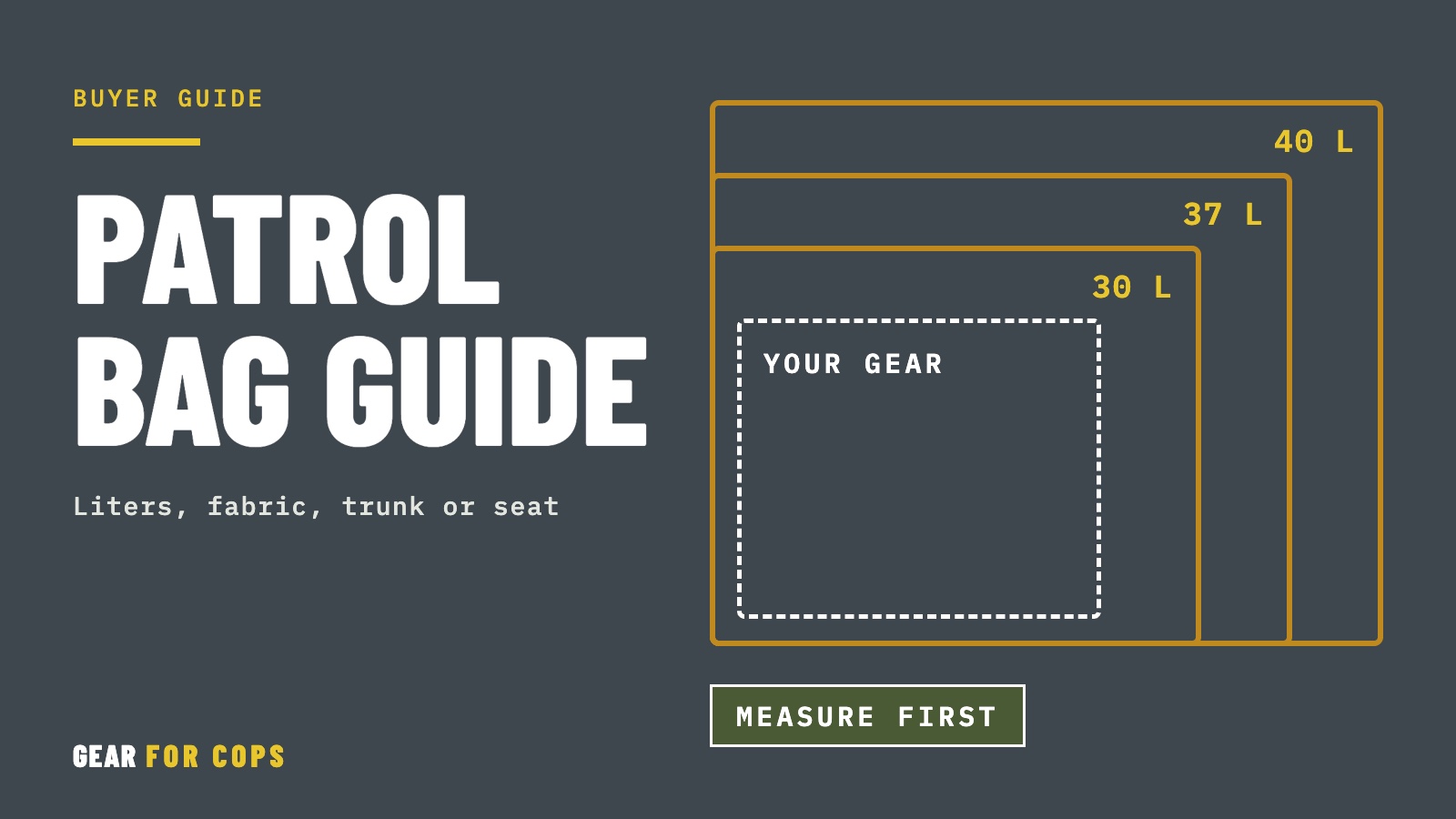
Measure what you carry first. Lay it out on a table, then pick the bag. Most people buy too large and fill the extra space with things they never use.
Fabric: denier, nylon, polyester and the word “Cordura”
The fabric line on a spec page is where marketing is thickest. Here is how to read it.
Denier (the “D”). A fabric retailer, Sailrite, explains it simply: “Denier (D) refers to fiber thickness — 500D Cordura is lighter, while 1000D Cordura offers increased durability.” A higher number means a thicker yarn, generally a heavier and tougher fabric. Sailrite lists its Cordura Classic nylon at 6.4 oz per square yard for 500D and 9.3 oz per square yard for 1000D. That is one retailer’s stock, not a universal rule. The point is that going from 500D to 1000D adds fabric weight to the bag, so you pay for the durability in pounds.
Nylon versus polyester. The two fibers are not the same. Sailrite describes its Classic Cordura as “100% high-tenacity nylon.” The 5.11 Patrol Ready and Basic Patrol bags, by contrast, are stated to be built from “all-weather 600D polyester.” The RUSH24 2.0 is “Water-repellent 1050D Nylon.” So a 600D polyester bag and a 1050D nylon bag are different materials, not just different numbers. We don’t have a head-to-head durability test, so we won’t say which one lasts longer. Denier alone doesn’t settle it, and the weave, coating and stitching also count.
Cordura. Cordura is a brand name for a family of fabrics, not a synonym for “tough.” None of the four product descriptions we read uses the word. If a listing says “Cordura,” look for the weight (500D or 1000D) and whether the maker says it is genuine branded fabric. If a listing says only “1000D nylon,” that is a spec, not a brand claim.
Water resistance. Words like “water-repellent” and “all-weather” describe a coating. They don’t mean waterproof. The Atomic Defense page lists “Waterproof design” as a feature without defining a test. We’d treat a patrol bag as splash-resistant and keep paper and electronics in resealable bags. Police1’s piece makes a similar point about liquids: “Put the bottle in a Zip-Loc bag to guard against leakage.”
Organization and features that matter on a shift
After size and fabric, these are the details that decide whether a bag is usable at 0300.
- A structured main compartment with removable dividers. 5.11 says the Basic Patrol Bag’s main compartment “can be arranged to personal spec with removable dividers.” Dividers keep a light from sitting on top of paperwork.
- An admin panel in the lid. Both 5.11 patrol bags list zippered and slip pockets on the lid interior. This is where pens, a notebook and cards go.
- A clear ID panel. The Patrol Ready lists a transparent ID panel. Useful if the bag rides with a spare uniform and a name tag.
- Baton loops. 5.11 lists “Hook & loop straps on top of back panel for baton.” If your agency doesn’t issue a baton, you won’t care.
- A shoulder strap you can remove. Both 5.11 patrol bags list one: the Patrol Ready a “Removable shoulder strap,” the Basic Patrol Bag an “Adjustable and removable shoulder strap.” Our view: a strap you can take off is less likely to snag in a trunk.
- Seat attachment. The Ultimate Patrol Bag lists removable straps that secure to the passenger seat.
- A stiff, padded base. The Patrol Ready lists “Fully padded construction for stability” and a “Structured bottom panel with external rubber feet,” which helps a trunk bag stand up.
- MOLLE webbing. The RUSH24 2.0 has “External front and side web MOLLE with 3×3 loop”; the Ultimate Patrol Bag lists exterior MOLLE straps. MOLLE lets you add pouches. It also makes the bag look like a tactical pack. Whether that matters depends on your assignment and your agency’s image.
- A frame sheet. The RUSH24 2.0 lists a “Lightweight high-density PE stay/frame sheet,” which keeps a pack from sagging when loaded.
- Water-bottle pockets. The Patrol Ready lists two front water-bottle pockets.
Features cost weight and money. Two or three of the above will do more for you than all of them.
Four example bags, with maker-published numbers
These are examples of what the numbers look like, not a ranking. We chose two patrol-specific bags from one maker, one seat-oriented bag from a smaller store and one backpack. We haven’t tested any of them. We tried to read First Tactical’s patrol bag pages too, but firsttactical.com returned an access-denied (403) error to every request we made on Nov. 12, 2026, so we could not confirm any First Tactical spec or price and left the brand out. That is a gap in our reading, not a judgment of the bags. Prices are what each product page showed on Nov. 12, 2026 and change often.
| Bag | Capacity (maker) | Main-compartment or overall size | Empty weight (maker) | Fabric (maker) | Price (Nov. 12, 2026) |
|---|---|---|---|---|---|
| 5.11 Basic Patrol Bag 37L | 2258 cu in / 37 L | Main compartment 12.5 in H x 18.5 in L x 8.5 in D | Not published on page | 600D polyester | $70 |
| 5.11 Patrol Ready 40L | 2442 cu in / 40 L | Main compartment 12.5 in H x 18.5 in L x 8.5 in D | 3.3 lb | 600D polyester | $90 |
| Ultimate Patrol Bag (Atomic Defense store) | 30 L | 18 in wide x 14 in high x 6 in deep | 3.7 lb | Not stated (“durable materials”) | $178.80 |
| 5.11 RUSH24 2.0 Backpack 37L | 37 L / 2,275 cu in | 20 in H x 12.5 in L x 8 in D | 3.85 lb (1.74 kg) | Water-repellent 1050D nylon | $99.49 sale (regular price $140) |
A few notes on the table.
The two 5.11 patrol bags have the same main-compartment size. Both also have a removable shoulder strap. The Patrol Ready page lists sized front pockets (10 in by 4.75 in by 1.5 in) and side pockets (10 in by 8.5 in by 1.5 in), two front water-bottle pockets, a padded structured bottom with rubber feet and lockable YKK zippers on the main compartment. The Basic page lists a front pocket, side pockets, baton loops and an admin panel, but no pocket dimensions or weight. The maker lists the Patrol Ready for “your trunk or cab.” Our reading: the extra pockets and padding are why it is rated 3 liters larger and costs $20 more. 5.11 doesn’t say that.
The Ultimate Patrol Bag is smaller on paper but built for the seat. Atomic Defense sells it, and the store’s product data names the vendor as 221B Tactical. Its 18 by 14 by 6 inch box is 1,512 cubic inches, about 24.8 liters by our arithmetic. The page’s 30-liter figure may include the expansion the page describes as “Two expandable inches of extra storage”; the page doesn’t say, so that is our guess. The page also lists hidden backpack straps, a clear ID card pocket and “16 storage compartments,” and says the bag can be carried over the shoulder, as a backpack or by hand. The page’s FAQ lists “Firearms” and “Magazines” among things you can carry. Whether you may leave a firearm in a vehicle is a matter of state law and your agency’s policy, so check both.
The RUSH24 2.0 is a backpack, not a patrol bag. 5.11 pitches it to “modern adventurers” and says “Whether in the city or venturing off the grid, this backpack delivers the features and performance required for a wide range of situations.” It also lists a hidden CCW pocket, a laptop sleeve and a 2-liter hydration pocket, and the page’s product data tags “Law Enforcement” as one of its purposes. 5.11 also files it under Police Duty & Patrol Bags. It is the one here with a frame sheet. At 3.85 lb empty it is the heaviest. Its outside dimensions (20 by 12.5 by 8 in) multiply to about 32.8 liters by our arithmetic, against the maker’s 37 L, so here too the pockets count. We include it because a lot of officers on walking posts carry a pack, not a duffel.
Prices move. 5.11’s RUSH24 page showed $99.49 against a $140 regular price on the day we checked. If you shop for the holiday, see our law enforcement discounts page for programs that may apply.
What officers pack: a checklist
There’s no national standard for what goes in a patrol bag. The best public source we found is a Police1 article by Tim Dees, “What’s in your patrol bag?” (dated June 02, 2026 on the page). It is not a survey. In the article’s words, “Police1 recently asked readers on Facebook for examples of items they carried in the field. Here are a few of the things they mentioned, with some embellishments and suggestions.” So treat it as a reader-sourced collection of ideas with the author’s additions, not a count of what most officers carry.
From that article, the items named include a reference book of local laws or department policies, a spare flashlight, replacement batteries, pens, a tape measure, flex cuffs and snips, a pry tool, a spring-loaded window punch, resealable bags, snacks, bottled water, wet wipes, a spare uniform, leather work gloves and chem lights. A few are surprising: dog treats and a leash, a stuffed animal for a frightened child, and Vicks VapoRub (Police1 files it under “The dirty-job essentials”).
The checklist below mixes those ideas with our own suggestions. We mark which is which. Your agency may require, forbid or issue some of these, and it may have rules on what you can carry in a county vehicle. Treat this as a prompt, not a policy.
| Group | Item | Source of the idea | Note |
|---|---|---|---|
| Admin | Pens, notebook, report forms, department policy reference | Police1 (pens, reference book) | Keep pens in a pocket that closes. Cheap pens to hand out is a Police1 tip |
| Admin | Phone cable, car charger, power bank | Our suggestion | Check that the cord fits your agency’s devices |
| Light and power | Spare flashlight and spare batteries | Police1 | Police1 says “Batteries leak or otherwise go bad, so check them from time to time.” See our lumens guide for choosing a light |
| Tools | Tape measure, ruler, pry tool, window punch | Police1 | Window punch and pry tool are the most agency-dependent, so check policy |
| Restraint spares | Flex cuffs and snips | Police1 | Your agency may issue and control these |
| Uniform | Spare shirt, spare socks, a jacket or coverall | Police1 (spare uniform, coverall) and our suggestion (socks) | Store clean items in a bag so they stay clean |
| Weather | Rain gear, hat, gloves, warm layer | Our suggestion; Ready.gov lists “warm clothes, blankets” for a vehicle kit | See our cold weather layering guide |
| Dirty work | Leather or cut-resistant work gloves | Police1 (leather work gloves) | See our police gloves guide |
| Hygiene | Wipes, sanitizer, trash bags | Police1 (wet wipes, hand sanitizer); our suggestion (trash bags) | Resealable bags of several sizes |
| Food and water | Bottled water, snacks | Police1 | Water in a resealable bag in case of leaks |
| Medical | Trauma kit and naloxone only if your agency issues or authorizes and trains you | Our suggestion; the Police1 list we read does not include a trauma kit or naloxone | Follow your agency’s medical protocol and training. See the heat note below |
| Scene | Chem lights, evidence bags, tape | Police1 (chem lights, resealable bags) | Whether you need evidence supplies depends on your role |
A note on heat and cold. Many items in a trunk go through the full range of weather. If your kit includes medication, read its label. The current NARCAN label on DailyMed says to “store at room temperature or refrigerated, between 2°C to 25°C (36°F to 77°F),” “do not freeze,” and “avoid excessive heat above 40°C (104°F).” A closed trunk in summer can exceed that, and we did not find a source for how hot a patrol car trunk gets, so we won’t give a number. Check the label on the product your agency issues, and ask your supply officer where it should be stored. This is label information, not medical advice; follow your agency’s medical protocol.
A note on the front seat. We don’t have a source on seat-belt, airbag or equipment-mounting rules for patrol vehicles, and they vary by vehicle and by agency. If your car has a laptop mount, a cage or a console, ask your fleet or equipment officer before you strap a bag to a seat.
Keeping the bag organized
A bag with everything in it is only useful if you can find the item. Four habits help.
- Group by use, not by size. Admin in the lid. Weather gear in one bag. Hygiene in another.
- Use a few small pouches. Resealable bags work. So do zip pouches in different colors.
- Put the heavy stuff low and near the back. A heavy item at the top of a standing bag pulls it over.
- Do a monthly check. Dees’ advice on batteries is a good rule for everything: check them. Look at the date on anything with an expiration, replace water and food, and swap seasonal gear.
If you walk with a backpack, weigh it. We have no sourced limit for a safe pack load, so we won’t invent one. A kitchen scale is enough to see if the pack has crept up since last month.
Policy and security
Two cautions apply to every bag.
Check what your agency allows. Many agencies control what goes into their vehicles. Lincoln (Nebraska) Police Department policy 1450, for example, says “Only issued and/or authorized apparel, uniform equipment, or accessories are to be worn or used.” That policy is about uniform and accessories, not bags specifically, but it shows the principle: an agency can limit what you bring. If you are unsure, ask your supervisor before you buy.
Treat the bag as sensitive. Whatever is in it, from reports to a laptop to medication, is worth locking up. Don’t leave a bag in plain sight in an unattended car. This is general common sense, not a cited rule, and your agency may have specific rules for storing equipment and records.
What we’d do first (our opinion)
If you are buying for yourself, this is how we would decide. It is our opinion, not a test result.
- Write down where the bag will ride. If the answer is “trunk,” buy a structured bag with dividers and a stiff bottom. If it is “front seat,” buy for strap attachment and a smaller footprint.
- Lay out your gear and measure it. Pick the smallest bag that holds it with room for a spare layer.
- Choose the fabric by how rough your use is. A 600D polyester bag that rides in a trunk is not subject to the same abuse as a 1050D nylon pack on your back.
- Weigh the empty bag. Where the maker gives a weight, add it to your pack weight.
- Skip features you will not use. MOLLE, hydration pockets and baton loops add cost.
If you are buying for someone else, see our gift lists. Gifts for police officers and what to get your squad for Christmas cover what officers use. A new recruit should wait: our police academy gear list explains why you may not need a bag until the department tells you what it issues.
How we chose what to include
We read four product pages and one editorial article, and we only report what those pages state. We chose two patrol bags and one pack from 5.11 because its pages publish liters, cubic inches and fabric. We added a seat-oriented bag sold by Atomic Defense for variety. We left out any bag whose page we couldn’t read, such as First Tactical’s (blocked with a 403 error on Nov. 12, 2026), and we don’t rank by officer votes here because we haven’t collected votes on bags yet. Nothing was tested. See how we pick for our standards, and Bags for the full category.
FAQ
What is the best patrol bag?
We don’t rank bags we haven’t tested. The best bag for you depends on where it rides and what you carry. A structured 37 to 40 liter bag with dividers suits a trunk. A smaller bag with seat straps suits the cab. A pack suits a foot post.
How big should a patrol bag be?
Measure your gear first. For most admin-plus-spare-uniform kits, 25 to 40 liters is the usual range among the bags we read (30, 37 and 40 liters). That is our guidance, not a standard.
What should I put in a police patrol bag?
Start with admin supplies, a spare light and batteries, a spare uniform, weather gear, water and snacks, gloves, and any medical items your agency authorizes. See the checklist in this guide. Police1’s article lists many more, but it is a reader-sourced collection, not a survey.
Is 1000D Cordura better than 500D?
A higher denier means thicker yarn and a heavier fabric. Sailrite, a fabric retailer, says “500D Cordura is lighter, while 1000D Cordura offers increased durability.” It also lists 6.4 oz per square yard for 500D and 9.3 oz for 1000D. The bag’s weave, coating and stitching also matter.
Do any of these bags say Cordura?
None of the four product descriptions we read uses the word. 5.11 describes 600D polyester and 1050D nylon, and the Ultimate Patrol Bag page does not name the fabric.
Is a backpack or a duffel better for a patrol bag?
A backpack is better if you walk. A duffel or box-style bag is easier to organize in a trunk. Weigh your loaded pack, because it rides on the same shoulders as your vest.
Where should a patrol bag go in the car?
Trunk for bulk, seat or cab for admin. If it is on the seat, strap it down. Ask your agency about mounting rules.
Can I leave medication in my patrol bag?
Read the label. The current NARCAN label on DailyMed says do not freeze and avoid heat above 104°F. Check the label on whatever your agency issues and ask your supply officer.
How often should I repack my bag?
Monthly is a good habit. Check batteries, expiration dates and seasonal items.
Does 5.11 have a discount for law enforcement?
Programs vary and change. See our law enforcement discounts page. We haven’t verified any 5.11 program for this guide.
Keep going
Choosing a belt? Start with duty belts officers named most and the Duty belts category. Armor questions: how to check if body armor is NIJ certified. Standing a long shift: police boots for standing all day. Off duty or retired: LEOSA explained. Browse lights for the spare light, gloves, cold weather gear, and officer picks.
Sources
All checked Nov. 12, 2026.
- 5.11 Basic Patrol Bag 37L. 2258 cu in / 37 L, main compartment dimensions, 600D polyester, removable strap, $70.
- 5.11 Patrol Ready 40L. 2442 cu in / 40 L, dimensions, 3.3 lb, 600D polyester, feature list, $90.
- 5.11 RUSH24 2.0 Backpack 37L. 37 L / 2,275 cu in, dimensions, 3.85 lb, 1050D nylon, $99.49 sale / $140 regular.
- Ultimate Patrol Bag, Atomic Defense store. 3.7 lb, 18 x 14 x 6 in, 30 L, seat straps, $178.80; vendor 221B Tactical in the store’s product data.
- Police1: What’s in your patrol bag?, Tim Dees, June 02, 2026. Reader-sourced (Facebook) list “with some embellishments and suggestions.”
- NARCAN nasal spray label, DailyMed. “Other Information” storage statements; label information updated August 17, 2026.
- Sailrite: What are different Cordura fabrics. Fabric retailer; denier and weight statements.
- Ready.gov: Winter weather. Vehicle kit list.
- Lincoln Police Department policy 1450. Authorized equipment statement.
- Autocomplete phrasing check: Google suggest queries run Nov. 11, 2026 for “best patrol bag” and “best duty bag.”