We may earn a commission if you buy through links on this page. It doesn’t change our picks or the data. Full disclosure.
TL;DR: Pick the glove by the job: thin leather for driving, shooting and cuffing; cut-resistant liners for searches around glass and blades; insulated gloves for winter. For cut-resistant gloves, read the ANSI/ISEA 105 level. It runs from A1 to A9, and each level is a band of grams of load in a lab test (A1 starts at 200 g, A9 starts at 6,000 g, as two published summaries of the standard give it). A higher letter-number is not a promise about the street. Makers say so themselves: Safariland writes “Cut-resistant gloves are not cut-proof,” and Damascus writes “No gloves are puncture or cut PROOF.” Many police glove pages list a European EN 388 code instead of an A-level, and the two scales are not interchangeable. Needle-resistance claims are the maker’s own test statements. We list what each maker states, with prices checked Nov. 12, 2026. We haven’t tested any glove. Check your agency’s glove policy before you buy.
In this guide
- Three jobs, three kinds of glove
- Reading ANSI/ISEA 105 cut levels A1 to A9
- EN 388 is a different scale
- Needle-resistant claims and their limits
- Examples, with maker-published specs
- Touchscreen: what the claim means
- Sizing and fit
- Winter gloves: warmth, dryness and use
- Gloves and agency policy
- Care and replacement
- How we chose what to include
- FAQ
- Keep going
- Sources
Three jobs, three kinds of glove
“Police gloves” covers at least three different products, and they trade off against each other.
- Duty gloves. Thin, close-fitting gloves for driving, writing, shooting, cuffing and handling gear. The product page of Hatch’s SG20P describes “a soft, ‘second-skin’ thin leather for excellent dexterity and feel whether shooting, searching, handcuffing, or driving.” Dexterity is the point.
- Search and cut-resistant gloves. Gloves with a protective liner or fiber layer for pat-downs, vehicle and property searches, and glass and debris at scenes. These add some cut resistance, and a few add a needle-resistance claim. They cost dexterity.
- Winter gloves. Insulated and often waterproof gloves for cold shifts, foot posts and traffic. Warmth comes at the cost of feel, which is why many officers switch gloves for different tasks.
Most officers end up with two or three pairs. A glove that is good at all three jobs doesn’t exist, and the pages we read don’t claim one does.
Reading ANSI/ISEA 105 cut levels A1 to A9
If a glove says it is cut-resistant, the claim is usually tied to a standard. In the U.S. that is ANSI/ISEA 105, American National Standard for Hand Protection Classification. It is published by the International Safety Equipment Association (ISEA), not by ANSI itself. We have not bought or read the standard, because it is sold. What follows comes from ISEA’s own news release and from glove makers who reproduce the tables.
What the 2024 edition changed. ISEA published an updated edition, ANSI/ISEA 105-2024, in November 2024. ISEA’s announcement of Nov. 21, 2024 quotes Dr. Andrew Funk, chair of the ISEA Hand Protection Product Group: “ANSI/ISEA 105-2024 does not make any major changes to test methods or levels of protection,” and “The big change is in product labeling.” The label is a pentagon badge. ISEA says “The Cut rating symbol is in the top center. The Abrasion rating symbol is on the left. The Puncture rating symbol is on the right,” and “An ‘X’ can be applied in place of a rating to indicate the classification was not tested or is not applicable.”
Words matter. In the same ISEA release, Funk says makers of conforming gloves “should not use terms such as ‘ANSI Cut’ or ‘ANSI 105.’” and should reference the standard as “ANSI/ISEA 105-2024.” So if you see “ANSI Cut 5” on a listing, the seller is using shorthand the standard’s owner discourages. The shorthand usually still means an A-level.
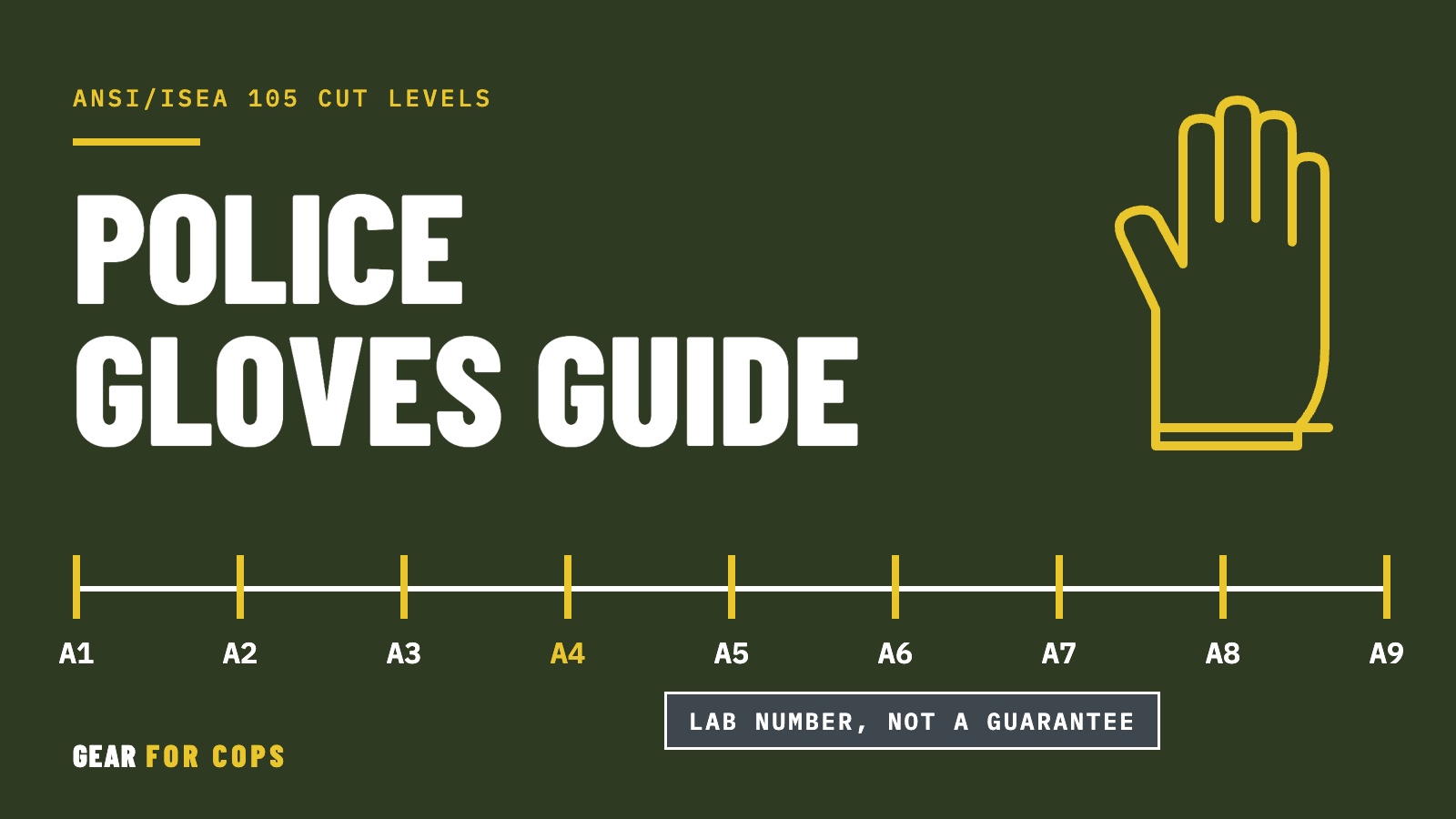
The scale. There are nine cut levels, A1 to A9, where A1 is the lowest and A9 is the highest. Each level is a band of load, in grams, measured in a lab test. ISEA sells the standard and its public release does not print the gram bands, so the table below comes from two published summaries that agree on every band: MCR Safety, a glove maker (its 2024 update page), and a June 8, 2016 ISHN trade-magazine article on the 2016 edition. ISEA says the 2024 edition made no major change to levels of protection, which is consistent with the 2016 bands still applying.
| Level | Cutting load (grams) |
|---|---|
| A1 | 200 to 499 |
| A2 | 500 to 999 |
| A3 | 1,000 to 1,499 |
| A4 | 1,500 to 2,199 |
| A5 | 2,200 to 2,999 |
| A6 | 3,000 to 3,999 |
| A7 | 4,000 to 4,999 |
| A8 | 5,000 to 5,999 |
| A9 | 6,000 or more |
Sources: MCR Safety, which lists “A9 ≥ 6000” and names the cut test method as ASTM F2992-15, and ISHN, June 8, 2016, which lists the same nine bands (“A9: 6000+ grams to cut”). We have not read the standard itself, so check it if a procurement decision rides on a number.
What “grams” means. In the test, a blade is drawn across the glove material under a load. The level tells you how much load it took to cut through, in a controlled setting. It is a way to compare materials. It is not a statement about a knife, a razor or a sharp piece of metal.
What the number does not tell you.
- Puncture is separate. The same pentagon has a puncture score, on a 0 to 5 scale (HexArmor, a glove maker, describes it as “from 0 (lowest) to 5 (highest)”). A glove can be A5 for cut and weak for puncture.
- Needles are a third test. Hypodermic needle resistance is its own test (ASTM F2878), not the puncture score. See the needle section below.
- Fit and wear change things. The test is on flat material. A seam, a worn spot or a loose finger isn’t the lab sample.
- Older gloves used older scales. The A1 to A9 scale arrived with the 2016 edition. ISHN’s 2016 article says the revision brought “the increase in the number of cut levels from five to nine,” partly because “the old cut level 4 category covered such a large range (from 1500 to 3499 grams),” and that the new levels “will now have an A in front of them, instead of just a number.” So an old “Level 4” without the A is from the earlier scale and doesn’t map one-to-one to an A-level. Check which edition a label refers to.
Bottom line: use the A-level to compare two gloves, not to decide a glove is safe against something.
EN 388 is a different scale
You will see a second code on many duty gloves: EN 388, a European standard. The Safariland page for the Hatch SGX11 says “CE certified/ EN388:2016 – 3X42D.” It does not list an A-level. The Damascus pages for the KX1 say “Tested to the EN388 4x32F,” and for the Patrol Guard Q5 they say the liners “exceed Level 5” on the EN 388 test, “their highest cut resistance level.”
Those are not the same as an ANSI/ISEA A-level. They are a different system with different tests and a different number of levels. Don’t convert one to the other. A “Level 5” on EN 388 is not an “A5.” If you need to compare two gloves, find the same standard on both, or ask the maker for the ANSI/ISEA 105 rating.
This is the biggest trap in police glove listings. Many pages quote EN 388 and say “cut resistant.” Others quote an A-level and say nothing about EN 388. They aren’t wrong. They are using different rulers.
Needle-resistant claims and their limits
Officers search pockets, waistbands, seats and bags, and sharps are a known hazard. A study by NIOSH researchers, “Needlestick Injuries and Other Body Substance Exposures Among Police Officers in a City Police Department” (de Perio, Victory and Groenewold, American Journal of Infection Control, March 2019, vol. 47, no. 3, pp. 294-297), looked at one city police department. The abstract doesn’t name the city; the CDC Stacks catalog record lists Ohio as the place studied. The authors used the city’s centralized human-resource database for all incidents from Jan. 1, 2011 to Dec. 31, 2016. According to the abstract, they found 13 needlestick injuries and 37 other body substance exposures. Needlestick injuries “most commonly occurred during pat-down searches and searches of property or vehicles,” and 9 source persons tested positive for hepatitis C. The annual rate ranged from 0 to 5.1 needlesticks per 1,000 officers, with no significant trend, and no incident reportedly led to transmission of a bloodborne virus. The authors wrote that “these appear to be rare events” but that officers in the department “are at risk,” and they recommended engineering, administrative and personal protective equipment improvements. It is one department, so it does not give a national rate.
Makers answer with needle-resistant gloves. Here is what we found, quoted as the maker states it.
- Damascus KX1 (synthetic puncture-resistant glove with KoreFlex II Micro-Armor): the maker calls it “the most advanced hypodermic needle protective gloves.” That is the maker’s claim. The page also says “Tested to the EN388 4x32F and ASTM F2878-10 Level 4-5.”
- The same page’s caution: “NOTE: No gloves are puncture or cut PROOF, and all have their limitations. Always use extreme caution when searching.”
Three limits to keep in mind:
- “Tested to” is not “proof against.” A test level describes how a material did on a specific needle under specific conditions. Real needles vary in gauge and angle.
- Coverage is part of the claim. Check which parts of the glove carry the protective layer. The KX1 page describes KoreFlex II Micro-Armor in “the entire palm with coverage on the finger tips.” The back of the hand is a knit.
- The maker’s number is the maker’s number. We haven’t seen a third-party lab report for any of these gloves.
Our opinion: treat a needle-resistant glove as one layer, not as the plan. Slow down, look before you reach, and use a light, as your training teaches.
Examples, with maker-published specs
These are examples of what each kind of glove looks like on paper, not a ranking. We didn’t test any. Prices are from each maker’s page on Nov. 12, 2026 unless the maker shows no price.
| Glove | Type | What the maker states | Standards on page | Price (Nov. 12, 2026) |
|---|---|---|---|---|
| Hatch SG20P Dura-Thin | Duty, dexterity | Soft thin leather, unlined, elasticized wrist; sizes S to XXL | CE EN420: 2003 | $40.16 |
| Hatch SGX11 Street Guard | Search, cut-resistant | Inner liner for “excellent cut-resistance around the entire hand”; synthetic palm with Extreme-Grip; sizes S to XXXL | EN388:2016 3X42D | $46.66 |
| Damascus Frisker K | Search, cut-resistant | Aramid fiber lined (“100% DuPont™ Kevlar® fiber” liners), aniline-finished cowhide, short cuff, water resistant; “moderate cut resistance” | None listed | Not listed |
| Damascus Patrol Guard Q5 | Search, cut-resistant | Razornet Ultra liners; non-slip hand cradle; neoprene and nylon back | EN 388, “exceed Level 5” | Not listed |
| Damascus KX1 | Search, needle-resistant | KoreFlex II Micro-Armor; touchscreen technology on index and thumb | EN388 4x32F; ASTM F2878-10 Level 4-5 | Not listed |
| 5.11 Patrol CR PrimaLoft Insulated | Winter, cut liner | Touchscreen compatible; PrimaLoft Gold 40 g (back of hand); cut resistance liner on palm | EN388:2016; EN ISO 21420; EN 511 | $60 |
| 5.11 Adiron PrimaLoft Insulated | Winter, waterproof | Tac Dry waterproof/breathable; PrimaLoft Gold 170 g back and 100 g palm; touchscreen PU palm and fingers | EN388:2016; EN ISO 21420; EN511 | $60 |
A few notes.
None of these pages lists an ANSI/ISEA 105 level. We looked at each maker page above and found EN codes or none. If you want an A-level, ask the maker or your department supplier. We won’t guess.
The SGX11’s own warning is a good read. The Safariland page says “Cut-resistant gloves are not cut-proof. Cut-resistant data is captured in a controlled laboratory setting. The data is intended to provide users a means of comparing potential glove performance but does not provide a definitive statement on the expected performance in real-world applications.”
The Frisker K says “moderate.” Damascus describes it as providing “moderate cut resistance from glass, razor blades and other hazards encountered during routine searches in the line of duty.” That wording is helpful. It describes an intended use and the level of protection the maker is willing to claim.
Winter gloves with a cut liner exist. The 5.11 Patrol CR combines a palm cut-resistance liner with 40 g of PrimaLoft Gold on the back of the hand. 40 g is a light insulation, so expect a cool-weather glove, not an arctic one. That is our reading of the number, not the maker’s claim.
Touchscreen: what the claim means
Almost every cold-weather glove advertises touchscreen compatibility now, because you use a phone, a tablet or a mounted laptop.
What the pages say:
- Damascus KX1: “Touchscreen technology on index and thumb.”
- 5.11 Adiron: “Touchscreen compatible PU palm & fingers.” The description adds that the palm and fingers work “for your phone/tablet/GPS use.”
- 5.11 Patrol CR: “Touchscreen compatible.”
What the pages don’t say is how well it works on your device. Screens differ, and a glove that works on a phone may be poor on a rugged in-car tablet. Two practical points, ours:
- Check which fingers are enabled. Index and thumb is common. If you type with two thumbs, you want both.
- Check that the touchscreen panel is not the same patch that wears fastest. Fingertips take abrasion. Look at how the maker attaches the conductive material and whether you can replace it.
If the touch panel stops working, you will pull the glove off, and then it doesn’t matter how warm it is. Try before you commit if you can.
Sizing and fit
A glove that fits too tight loses dexterity. One that is too loose gets in the way of the trigger guard and the radio. Glove makers publish size charts. Use theirs.
- Sizes vary by maker. Hatch lists the SG20P in S to XXL and the SGX11 in S to XXXL. Damascus lists XSM to XXLG on the pages we read. Sizes aren’t standardized across brands.
- Measure the way the maker says. Common practice is to measure around your dominant hand across the knuckles, but each maker publishes its own chart, and Damascus has a “Find Your Glove Size” page. We couldn’t read its chart, so we can’t tell you its method.
- Fit liners and insulation differently. A glove with a liner is thicker inside. If you size by a thin duty glove and buy a lined winter glove, expect a tighter fit.
- Try them with your gear. Put your hand on your holster, on the radio and on the light. Check you can work the clip on your cuffs. Do this with the glove on.
- Leather stretches. The SG20P is thin leather and unlined, so it may give a little with wear. Don’t buy it a size big to “allow for stretch” unless the maker says to.
Winter gloves: warmth, dryness and use
Official cold-stress guidance is blunt about hands. The OSHA Quick Card on protecting workers from cold stress lists, under how to protect yourself, “Layers of loose-fitting, insulating clothes,” “Insulated jacket, gloves, and a hat (waterproof, if necessary),” and “Insulated and waterproof boots.” NIOSH’s cold-stress page adds: “Make sure to protect the ears, face, hands, and feet.” Neither one picks a brand or a rating for you.
What we’d weigh for a winter patrol glove:
- Insulation. 5.11 gives PrimaLoft Gold in grams: 40 g on the Patrol CR, and 170 g (back) and 100 g (palm) on the Adiron. More grams is warmer and bulkier. Compare grams within one maker’s line.
- Waterproofing. The Adiron lists 5.11’s “Tac Dry® waterproof/breathable system.” The Patrol CR page does not make a waterproof claim.
- Cut liner. The Patrol CR has one on the palm. The Adiron page doesn’t list a cut claim.
- Dexterity. Thick gloves cost feel. Many officers keep a thin pair for tasks that need it. Our cold weather patrol layering guide covers how gloves fit with the rest of the system, and the Cold weather category has more.
- Stay dry. Wet gloves make hands colder. Keep a spare pair in the car.
Remember the cold-stress basics: OSHA’s card lists risk factors such as “Dressing improperly, wet clothing/skin, and exhaustion.” For frostbite, it says “Do not rub the frostbitten area.” It is a worker-safety card, and none of this is medical advice. If you think you have frostbite, get medical care and follow your agency’s protocol.
Gloves and agency policy
Uniform and equipment policies often name gloves, or fold them into authorized uniform equipment. For example, Lincoln (Nebraska) Police Department policy 1450 says “Only issued and/or authorized apparel, uniform equipment, or accessories are to be worn or used.” That wording isn’t specific to gloves, but it shows how an agency can limit what you buy. Ask your supervisor or equipment officer:
- Does the department issue duty or search gloves?
- Are privately purchased gloves allowed? Any color or logo rules?
- Are needle-resistant or cut-resistant gloves required for searches?
- Does policy say how to document a needle-stick or exposure?
Your department’s answers beat anything in a buying guide.
Care and replacement
We don’t have a sourced replacement interval for police gloves. These are common-sense habits, ours:
- Inspect before each shift. Check the fingertips, the seams and the palm for holes, thin spots and cuts.
- Retire damaged gloves. A cut-resistant glove that has been cut has done its job once.
- Follow the maker’s care label. Washing can change coatings, liners and leather. Damascus lists a “Care For Your Gear” page on its site.
- Keep a spare. One pair on your belt or in the bag, and one in the car.
If a glove is contaminated with blood or other body fluids, follow your agency’s exposure protocol.
How we chose what to include
We picked gloves from three makers (Hatch by Safariland, Damascus Gear and 5.11) whose product pages we could open and read in full. We included one per category: duty, search, cut-resistant, needle-resistant and winter. We reported only what the page says. Where a page lists only an EN code, we said so. We didn’t rank, we didn’t test, and we didn’t convert EN codes to A-levels. See how we pick for our standards, and the Gloves category for more.
FAQ
What are the ANSI/ISEA 105 cut levels?
Nine levels, A1 to A9, from lowest to highest. Each is a band of load in grams from a lab cut test. MCR Safety and a 2016 ISHN summary both list A1 at 200 to 499 g and A9 at 6,000 g or more. The A-scale dates from the 2016 edition; the earlier scale had five levels.
Is an A5 glove cut-proof?
No. Safariland’s page says “Cut-resistant gloves are not cut-proof,” and the data comes from a controlled laboratory setting.
Is EN 388 the same as ANSI/ISEA 105?
No. They are different standards with different scales. Don’t convert one to the other.
Do needle-resistant gloves stop needles?
Makers say they resist them under test. Damascus says its KX1 was “Tested to the EN388 4x32F and ASTM F2878-10 Level 4-5,” and also says “No gloves are puncture or cut PROOF.”
How common are needlesticks in police work?
One city police department study (NIOSH researchers, 2019) found 13 needlestick injuries and 37 other body substance exposures from 2011 to 2016, most often during pat-downs and property or vehicle searches. The authors called them rare events that still put officers at risk. It’s one department, so it isn’t a national rate.
What is the best glove for searching?
We don’t rank. Look for the protection claim in the standard you want (ANSI/ISEA 105 level, or EN 388 code), the coverage, and how the glove feels with your hands. Policy may decide for you.
What is the best glove for driving and shooting?
A thin, close-fitting glove, such as the Hatch SG20P, which the maker describes as built for dexterity “whether shooting, searching, handcuffing, or driving.” It has no cut or puncture rating on the page.
How do I know if a winter glove is touchscreen compatible?
The page will say so, and some name which fingers. Whether it works on your device is something you test.
How should a police glove fit?
Snug without limiting your fingers. Follow the maker’s size chart and check it with your gear on.
Do police departments restrict glove purchases?
Many restrict uniform equipment. Lincoln policy 1450 says only “issued and/or authorized” equipment is to be worn or used. Ask your agency.
Keep going
Building a loadout? See duty belts officers named most and duty belt weight. For the light you hold while wearing them, read how many lumens you need on patrol. Standing in the cold: police boots for standing all day. Body armor basics: how to check body armor against the NIJ list. Gear for a bag: our patrol bag guide. Gifts: gifts for police officers, academy graduation gifts, police academy gear list and what to get your squad for Christmas. Off duty: LEOSA explained. Discounts: law enforcement discounts. Browse Gloves, Lights and Officer picks.
Sources
All checked Nov. 12, 2026.
- ISEA: ISEA Announces Updated ANSI/ISEA 105 Hand Protection Standard, Nov. 21, 2024. Label layout, “no major changes to test methods,” naming guidance.
- MCR Safety: ANSI/ISEA Standard 105-2024 Update. A glove maker’s reproduction of the A1 to A9 table; ASTM F2992-15.
- ISHN: New glove testing standards, Alex Carrillo-Hayley, June 8, 2016. Five-to-nine level change, A prefix, the same gram bands.
- HexArmor: What’s new in the ANSI/ISEA 105-2024 hand protection standard, June 4, 2025. Puncture 0 to 5 scale. Note: HexArmor’s page says the cut rating is “Located at the top right of the pentagon.” ISEA, which publishes the standard, says “The Cut rating symbol is in the top center,” and we follow ISEA.
- Safariland: Hatch SGX11 Street Guard and Hatch SG20P Dura-Thin.
- Damascus Gear: KX1, Frisker K and Patrol Guard with Razornet Ultra liners.
- 5.11 Patrol CR PrimaLoft Insulated Glove and 5.11 Adiron PrimaLoft Insulated Glove.
- de Perio MA, Victory KR, Groenewold MR. Needlestick injuries and other body substance exposures among police officers in a city police department. Am J Infect Control 2019;47(3):294-297 (CDC Stacks record) and PubMed abstract, PMID 30318400.
- OSHA Quick Card: Protecting Workers from Cold Stress (OSHA 3156-02R 2014).
- NIOSH: Cold stress.
- Lincoln Police Department policy 1450.
- Autocomplete phrasing check: Google suggest queries run Nov. 11, 2026 for “best police gloves.”